 Meet Qimei at PLMA Chicago 2026 · November 15–17, 2026 · Booth #H3029










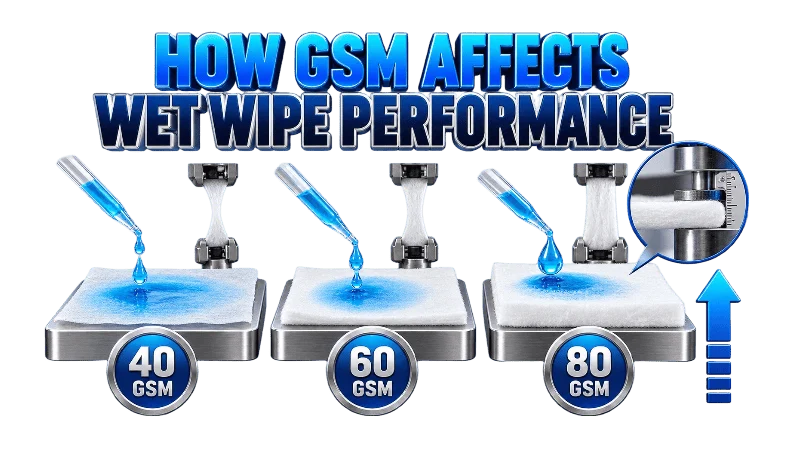
GSM is one of the first specifications buyers see in a wet wipes quotation.
A supplier may offer 40 GSM, 50 GSM or 60 GSM material. It is tempting to assume that the higher number always means a better wipe. In reality, GSM affects performance, but it does not define performance by itself.
Two wipes can have the same size and similar packaging, yet feel completely different because their GSM, fiber blend, density, texture and formula are different.
For private label wet wipes, GSM should be treated as part of a complete material specification. It matters, but it should never be the only material requirement.
What Does GSM Mean in Wet Wipes?
GSM means grams per square meter. In the nonwovens industry, it is called basis weight: the mass of fabric per unit area.
If a material is specified as 60 GSM, one square meter of its dry nonwoven fabric has a nominal mass of 60 grams.
GSM is useful because it allows buyers to compare material weight without being affected by wipe dimensions. However, it does not tell a buyer:
- The fiber composition
- The thickness of the material
- The fabric density
- The surface pattern
- The wet strength
- The absorption capacity
- The lotion-loading level
- The final consumer experience
This is why a specification that only says “60 GSM spunlace” is incomplete.
How GSM Changes Wipe Thickness and Hand Feel
When other variables are similar, a higher GSM usually means more fiber is present in the same area. This can make the wipe feel fuller, heavier or more substantial.
However, GSM and thickness are not the same measurement.
A loose and bulky material may feel thick at a moderate GSM. A highly consolidated material with the same GSM may feel flatter and denser. Fiber type, web structure and hydroentanglement conditions all affect the final thickness.
Research on hydroentangled fabrics has shown that basis weight, fiber type and water-jet pressure interact to influence fabric thickness, density and tensile properties.
For wet wipes manufacturers, this means a 50 GSM wipe can sometimes feel thicker than another 60 GSM wipe. The difference may come from the material structure rather than the amount of fiber alone.
A soft baby wipe may need a lofty, gentle hand feel. A household-cleaning wipe may need a denser, more durable feel. The correct GSM depends on the product goal.
How GSM Affects Strength
Higher GSM can improve strength because there is often more fiber available to share the pulling force. But this is not a guaranteed result.
Wet strength depends on several factors:
- Fiber composition
- Fiber length and fineness
- Web orientation
- Hydroentanglement intensity
- Surface pattern
- Fabric density
- Formula compatibility
Hydroentanglement uses high-pressure water jets to entangle fibers and build fabric integrity. The process settings affect how closely the fibers are bonded together.
A study on hydroentangled nonwovens found that higher jet pressure increased fabric breaking load but could reduce liquid absorption capacity. Another study using cotton hydroentangled nonwovens found that increasing applied energy increased tensile strength in both machine and cross directions while reducing elongation.
In practical terms, a lower-GSM material with a suitable fiber blend and strong bonding can outperform a heavier material with poor structure or weak wet performance.
That is why buyers should request both dry and wet tensile results when strength is important.
How GSM Influences Absorbency and Lotion Loading
GSM affects the amount of dry material available to hold liquid. A heavier wipe may hold more lotion per sheet when the fabric structure and fiber type are suitable.
But more GSM does not automatically mean better absorption.
Absorbency is also influenced by fiber chemistry, porosity, density and the hydroentanglement process. A dense structure may hold and release liquid differently from a more open structure. A cellulose-rich material and a polyester-rich material can also respond differently to the same formula.
Research on household wipe materials has evaluated mass per unit area, thickness, density, dry and wet tensile properties, as well as liquid absorption and simulated-use durability. This shows that absorbency should be assessed alongside strength and service performance—not in isolation.
For a finished wet wipe, lotion loading is a separate specification from GSM. A larger or heavier wipe generally needs more formula to reach the intended moisture level. This can increase formula consumption, finished product weight and shipping cost.
The goal is not to load as much liquid as possible. The goal is to create a wipe that feels consistently moist, cleans effectively and does not drip, dry out or cause double dispensing.
How GSM Affects Packaging and Dispensing
A GSM change can affect more than the wipe itself. It can also change the finished pack.
If the wipe dimensions and sheet count stay the same, a higher-GSM material usually creates a larger stack. A larger stack may require a taller pack or stronger compression during packing.
Too much compression can affect dispensing. The first wipes may become harder to pull out. Several sheets may come out together. The next wipe may fail to remain accessible at the opening.
A lower-GSM material may create a slimmer pack, but the wipe still needs enough strength for cutting, folding, dispensing and normal use.
For this reason, wet wipes production should always include finished-pack testing. A loose nonwoven swatch cannot show how the material will behave after it has been folded, loaded with formula and compressed inside a soft pack or canister.
Custom printed wet wipes manufacturers and suppliers should also finalize the material before approving packaging film. A change in GSM may require adjustments to pack dimensions, film layout, lid position or carton configuration.
How GSM Influences Cost
GSM is one of the main cost drivers in wet wipes manufacturing because it affects how much nonwoven fabric is used per wipe.
For a fixed wipe size and pack count, a higher GSM normally means higher material consumption. If the finished wipe also needs a higher formula loading, the total product weight may increase further.
However, choosing the lowest possible GSM is not always the most economical decision.
A wipe that tears easily, feels too thin or requires consumers to use two sheets instead of one can damage the brand experience. It may also lead to complaints or poor repeat purchases.
The best value is usually the lowest material weight that still delivers the agreed performance.
For branded wet wipes, this balance should support the brand position:
| Product Goal | GSM Consideration |
|---|---|
| Value retail wipes | Control material cost while maintaining basic strength and moisture |
| Premium baby wipes | Focus on softness, hand feel, wet strength and consumer comfort |
| Household cleaning wipes | Balance durability, liquid release and surface-cleaning performance |
| Industrial or workshop wipes | Prioritize strength, size and resistance to tearing |
| Bulk wet wipes | Consider pack efficiency, carton weight and the intended commercial use |
Why Fiber Composition Still Matters More Than Many Buyers Expect
A 60 GSM fabric made from one fiber blend is not automatically comparable to a 60 GSM fabric made from another blend.
Viscose, lyocell, polyester, cotton and wood-pulp-based materials have different properties. The ratio of fibers changes the wipe’s softness, strength, resilience, absorbency and surface behavior.
Nonwoven performance is influenced by a combination of fiber diameter, orientation, packing density and basis weight.
This is especially relevant for wet wipes manufacturers in China and global suppliers comparing materials from different nonwoven sources. Two suppliers may both quote the same GSM, but the materials may still have different fiber ratios, thicknesses and finished-pack results.
The buyer should ask for the full material description, not only the GSM.
What Should Buyers Test Beyond GSM?
A stronger specification makes it easier to compare suppliers and avoid misunderstandings during mass production.
Useful test points include:
- Fiber composition and blend ratio
- Nominal GSM and tolerance
- Thickness under an agreed test method
- Dry tensile strength
- Wet tensile strength
- Elongation
- Absorption capacity
- Liquid release during use
- Linting or fiber shedding
- Surface pattern and appearance
- Wipe dimensions
- Finished-pack dispensing performance
A 2022 study of baby wet wipes compared hydroentangled materials using mass, thickness, liquid absorption capacity, air permeability and dry and wet tensile measurements. These are practical indicators for buyers evaluating wet wipe performance.
EDANA’s Nonwovens Standard Procedures provide harmonized test methods that allow suppliers and buyers to describe, produce and test nonwoven properties more consistently across the supply chain.
How to Choose the Right GSM for a Wet Wipe Project
There is no universal “best GSM” for wet wipes.
The right starting point depends on the product application, wipe size, target retail price, formula, material blend and pack format.
Before asking a wet wipes supplier for a quotation, buyers should define:
- Intended use of the wipe
- Target market and retail channel
- Required wipe size
- Preferred fiber composition
- Desired hand feel
- Required strength during use
- Pack count and pack format
- Formula type and fragrance preference
- Target price range
- Required claims and documentation
This information helps the supplier recommend suitable material options rather than simply offering the highest or lowest GSM available.
For OEM wet wipes projects, it is often useful to compare two or three finished material options. For example, a buyer may test a lighter value option, a mid-range option and a premium option with the same formula and pack format.
That comparison gives a more realistic view of cost and consumer experience than judging GSM figures alone.
Final Thoughts
GSM has a direct effect on wet wipe material use, stack height, finished-pack weight and cost. It can also influence hand feel, thickness, absorption and strength.
But GSM does not define wipe quality by itself.
Fiber blend, fabric density, hydroentanglement, surface texture, formula compatibility and packaging design all affect the finished product. A well-designed 45 GSM or 50 GSM wipe may be more suitable than a poorly designed 60 GSM wipe.
For private label wet wipes, the best approach is to compare finished samples, agree on measurable material requirements and approve the full specification before bulk production.
QIMEI supports OEM and private-label wet wipes with material selection, formula development and custom packaging. Contact our team to compare GSM options and develop a wipe that matches your market, performance target and budget.
References
- INDA. Nonwovens Glossary of Terms. Defines basis weight as the weight of a unit area of fabric.
- EDANA. How Are Nonwovens Made? Explains web formation and hydroentanglement in nonwoven production.
- Khatri, A., et al. (2021). Effect of Material Properties and Process Parameters on Properties of Hydroentangled Nonwoven Fabrics. The Journal of The Textile Institute. https://doi.org/10.1080/00405000.2020.1791398
- Ogunleye, C., & Anandjiwala, R. (2016). Development of Hydroentangled Nonwoven Fabrics for Protective Garments. Journal of Engineered Fibers and Fabrics. https://doi.org/10.1177/1528083715580520
- Hron, R. J., Hinchliffe, D. J., & Condon, B. D. (2020). Optimized Hydroentanglement Processing Parameters for Nonwoven Fabrics Composed Entirely of Cotton Fibers. Journal of Engineered Fibers and Fabrics. https://doi.org/10.1177/1558925020935436
- Soukupova, V., Boguslavsky, L., & Anandjiwala, R. D. (2007). Studies on the Properties of Biodegradable Wipes Made by the Hydroentanglement Bonding Technique. Textile Research Journal, 77(5), 301–311. https://doi.org/10.1177/0040517507078239
- Cheriaa, R., & Boubaker, J. (2022). Quality Assessment of Baby Wet Wipes. Journal of Engineered Fibers and Fabrics. https://doi.org/10.1177/15280837211046619
- EDANA. Nonwovens Standard Procedures.