 Meet Qimei at PLMA Chicago 2026 · November 15–17, 2026 · Booth #H3029




Choosing a wet wipes supplier used to feel relatively straightforward. A buyer would request samples, compare quotations, review packaging options and select the factory that offered the best balance of quality and price.
That process still exists, but it no longer tells the whole story.
In 2026, brands sourcing private label and OEM wet wipes are facing a more complex decision. A sample may look excellent, but the real question is whether the same product can remain consistent across repeat orders, changing raw-material batches, high-speed production and long-distance shipping.
This is why the way buyers evaluate wet wipes manufacturers is changing. The focus is moving away from one attractive sample and toward the complete manufacturing system behind it.
Quality Is No Longer Defined by a Single Sample
A wet wipe sample can show important things. It can show whether the material feels soft, whether the formula is pleasant, whether the package looks premium and whether the wipe is easy to remove.
However, a sample does not always show how the product will perform after several production runs.
During wet wipes manufacturing, small variations can influence the finished product. A slight difference in fabric thickness, lotion loading, embossing, folding tension or sealing pressure can affect how the wipes feel and dispense. These changes may be minor in one pack but become noticeable when a brand receives thousands of packs across several shipments.
For this reason, experienced buyers are starting to look beyond the question, “Is this sample good?”
They ask more useful questions:
- Can this specification be repeated consistently?
- How does the supplier control material changes?
- What happens if the pack count or wipe size changes?
- Can the factory maintain performance during larger production runs?
- How are problems handled if they appear after shipment?
The best wet wipes manufacturers are not defined only by how well they prepare a sample. They are defined by how reliably they reproduce the approved product over time.
Wet Wipes Raw Material Is Now Evaluated by Performance

In the past, buyers often selected a wipe material by category: viscose, polyester, bamboo, cotton, lyocell or wood pulp. Today, that is only the first step.
Wet wipes raw material must be evaluated by how it behaves in the complete product. The same fabric can perform differently depending on its fiber ratio, GSM, surface pattern, formula loading, fold type and packaging pressure.
For example, a softer nonwoven may create a more premium feel for baby wipes or facial wipes. But it may also absorb more liquid, change the stack height or increase the risk of multiple wipes coming out together. A stronger material may improve durability, but it may feel too firm for sensitive-skin positioning.
This is why a material sample should never be approved in isolation. Buyers should test the intended fabric with the final formula and packaging format.
A reliable wet wipes supplier should be able to explain the practical trade-offs between softness, wet strength, absorbency, cost and dispensing performance. That discussion is far more valuable than simply being offered the highest GSM or the lowest price.
OEM Wet Wipes Projects Require Earlier Specification Control

OEM wet wipes development is no longer just about adding a customer logo to a standard product. Brands want more control over formulas, materials, packaging formats and market positioning.
A clear specification should be agreed before printed film is approved. It should include:
- Product application and target consumer
- Fabric composition, GSM and surface texture
- Open wipe size and folded dimensions
- Formula direction and fragrance preference
- Lotion loading level
- Pack count and folding method
- Closure type and packaging-film structure
- Required claims and label language
- Testing requirements and destination market
- Carton configuration and shipping expectations
Without this information, it is difficult to compare quotations accurately. Two suppliers may both quote a “60-count wet wipe pack,” but the actual products may have completely different materials, wipe sizes, formulas and packaging structures.
For a brand, the specification is not extra paperwork. It is the reference point that protects product consistency from sampling through to mass production.
Why Production Stability Matters More Than Line Speed
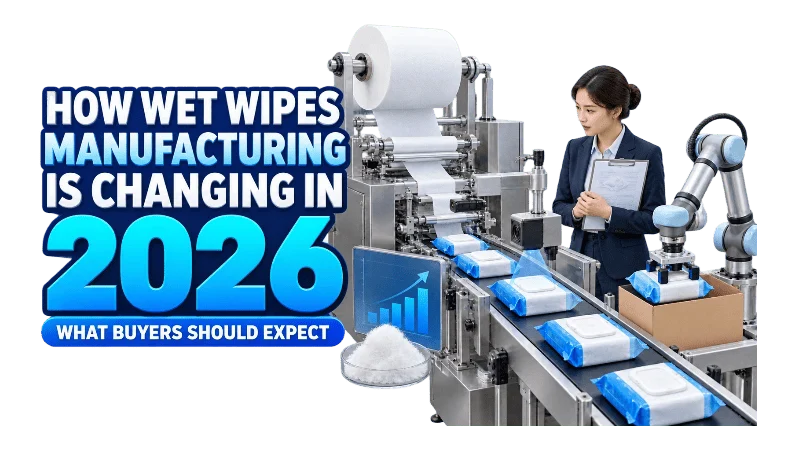
Most buyers expect a wet wipe factory to have production lines and packaging machines. But machinery alone does not guarantee stable output.
Wet wipes production depends on many connected variables. Material rolls must meet the approved specification. The formula must be mixed consistently. The liquid dosage must remain within the required range. The folding process must align with the pack opening. The sealing process must protect the wipes from moisture loss.
If one part of the system changes, the consumer experience can change too.
For example, a tighter pack may improve shelf appearance but make the first wipe more difficult to remove. A larger opening may make dispensing easier, but it may also cause the next wipe to fall back into the pack. A higher lotion level may improve the feeling of moisture, but excessive liquid can lead to double dispensing or leakage.
A professional wet wipes manufacturer understands these interactions. Instead of treating every issue as separate, the factory looks at the product as a complete system.
This is especially important for brands expanding from a first order into regular retail supply. The production setup must be stable enough to support repeat orders, not only one successful launch.
Compliance Has Become Part of Everyday Manufacturing
Compliance used to be treated as a final stage before shipment. Buyers would ask for certificates, review the artwork and confirm that the paperwork was complete.
Today, compliance needs to be considered much earlier.
Claims such as “biodegradable,” “plastic-free,” “flushable,” “antibacterial,” “fragrance-free” or “suitable for sensitive skin” can affect material selection, formula design, testing requirements and label wording. These claims should not be added simply because they are popular in the market.
A wet wipes supplier should help buyers assess whether a claim is appropriate for the actual product. For example, a plastic-free wipe is not automatically flushable. A water-based formula is not automatically preservative-free. A plant-based material does not automatically support every environmental claim.
The strongest OEM wet wipes partners do not treat compliance as a document to send after production. They build it into the development process, from raw-material selection and formulation to packaging statements and finished-product checks.
This approach reduces the risk of expensive artwork changes, customs delays or consumer complaints after launch.
Packaging Is Becoming a Core Product Decision
For many buyers, packaging was once mainly a branding decision. The priority was to create an attractive pack that could stand out on the shelf.
That is still important, but packaging now has a wider role in wet wipes manufacturing. It influences moisture retention, dispensing, transport performance, shelf appeal and consumer convenience.
When brands evaluate custom printed wet wipes manufacturers and suppliers, the packaging discussion should begin alongside fabric and formula selection—not after the wipe has already been approved.
A printed soft pack, flip-top pack, travel sachet, refill pack or canister each creates different technical requirements. The pack must fit the folded stack correctly. The opening should support one-at-a-time dispensing. The film must seal consistently and protect the wipes throughout the product’s shelf life.
For branded wet wipes, packaging also carries critical information: product claims, ingredient details, disposal instructions, batch coding and market-specific labeling. A visually attractive design is not enough if the pack does not perform well in production or shipping.
The best approach is to approve packaging using finished-product samples. This allows the brand to evaluate the product exactly as the consumer will receive it.
Scalability Reveals the Difference Between Suppliers
A supplier may perform well on a small sample order but struggle when production volume increases. This is one of the most common risks in private label development.
As order quantities grow, the factory must manage more material rolls, longer machine runs, more frequent quality checks and more complex packing schedules. Small deviations that are difficult to notice in low-volume sampling can become much more visible at scale.
Brands should therefore evaluate scalability early. Useful questions include:
- What is the factory’s normal production range for this pack format?
- Can the same material and formula be secured for repeat orders?
- How are raw-material substitutions controlled?
- What happens if production needs to increase quickly?
- Can the supplier support multiple SKUs or destination markets?
- How are quality issues recorded and corrected?
The goal is not simply to find a factory that can make one order. It is to find a manufacturing partner that can support the brand as it grows.
The Relationship Between Brand and Manufacturer Is Changing
The relationship between buyers and wet wipes manufacturers is becoming more collaborative.
Brands are no longer only searching for a supplier that can provide the lowest quotation. They need a partner that can help them make practical decisions about material selection, formula development, packaging, MOQ and production timing.
This does not mean that price is unimportant. It means price should be evaluated together with consistency, communication, technical support and supply reliability.
A lower-cost product can become expensive if it leads to complaints, rejected cartons, repeated artwork changes or unstable repeat orders. On the other hand, a well-designed specification can prevent unnecessary costs before production begins.
For brands launching new products, this partnership is particularly valuable. A factory with OEM wet wipes experience can identify potential issues before printing and production, when changes are still manageable.
What Buyers Should Look for in 2026
The most reliable wet wipes supplier is not always the one with the most impressive catalog or the lowest initial quote. Buyers should look for evidence of stable systems and clear communication.
A capable partner should be able to:
- Recommend suitable wet wipes raw material options
- Explain how fabric, formula and packaging affect each other
- Produce representative samples for approval
- Support custom printing and branded wet wipes development
- Control product changes through an agreed specification
- Provide practical guidance on claims and target-market needs
- Maintain consistent wet wipes production across repeat orders
- Respond clearly when technical questions or quality issues arise
These capabilities matter because they reduce uncertainty. The buyer gains more control over the final product, while the manufacturer gains a clearer reference for production.
Final Thoughts
Wet wipes manufacturing in 2026 is no longer judged only by the appearance of a sample. Buyers are looking more closely at material behavior, packaging performance, compliance control and repeat-order stability.
For private label brands, the best decision is to select a supplier that can turn a product idea into a clear, repeatable manufacturing specification.
QIMEI supports OEM wet wipes projects with customizable materials, formulas, packaging formats and branded wet wipes solutions.
Contact our team to discuss your product concept, target market and production requirements.