 Meet Qimei at PLMA Chicago 2026 · November 15–17, 2026 · Booth #H3029
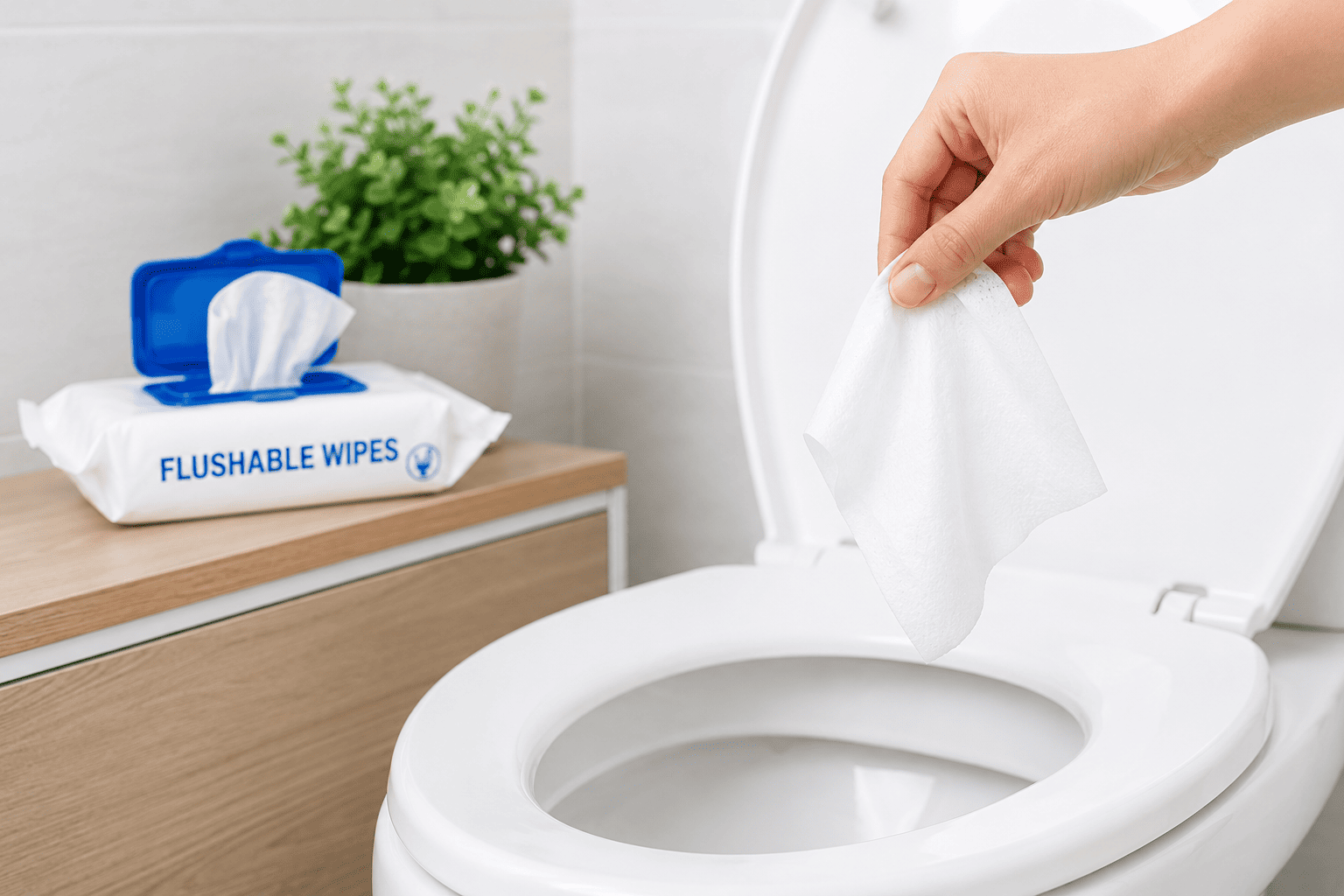


A flushable wipe is not tested by dropping it into a cup of water and watching it break apart.
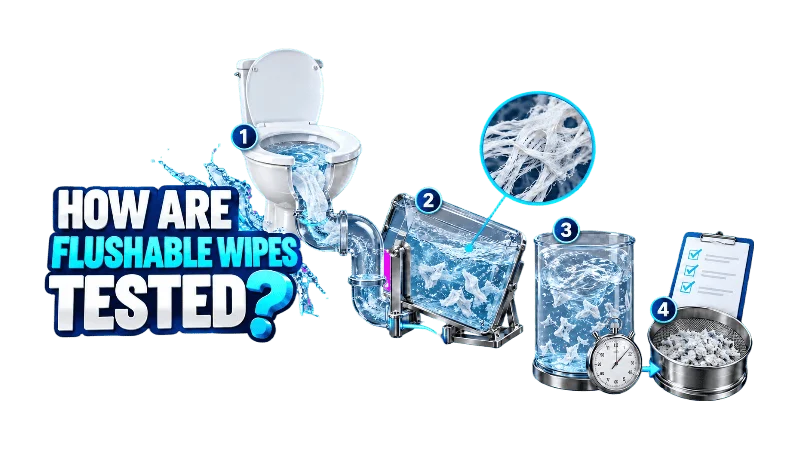
Real flushability testing looks at what happens after a wipe is flushed. Can it clear the toilet? Can it move through the drain line? Does it disintegrate under controlled conditions? How does it behave during wastewater treatment?
These questions matter because a wipe may feel soft, be plastic-free or use cellulose-based material, yet still be unsuitable for disposal through a toilet. A flushable claim needs evidence for the finished product, not just a description of the wet wipes raw material. [1][2]
This guide explains the main testing stages used for flushable wipes. It is written for private label brands, retailers, importers and distributors that need to understand what to ask a flushable wipes manufacturer before approving packaging claims.
Why Flushability Needs More Than One Test
Wastewater systems are not all the same. A wipe first passes through a toilet and household drain line. It may then move through a sewer network, pumping equipment and a wastewater treatment plant.
That is why one disintegration test cannot answer every question.
IWSFG PAS 1:2020 identifies five areas that a product must address to be recognized as suitable for flushing under its specification:
- Environmental protection and material composition
- Toilet and drain-line clearance
- Disintegration
- Settlement
- Biodisintegration [2]
The INDA/EDANA GD4 framework also uses a group of tests covering performance in pipes, pumps, household septic systems and municipal wastewater treatment systems. INDA states that GD4 includes seven flushability assessment tests. [3]
The practical rule is clear: a product should be assessed as a system. Passing one test does not automatically support a flushable claim.
Step 1: Test the Right Finished Product
The sample sent for testing should represent the product that will be sold.
IWSFG PAS 3 states that, when a test supports a flushable claim, the tested sample should be the same as the product offered in the intended market. For moist tissues, one specimen is one sheet. [4]
This is important for OEM wet wipes projects. A change to the fabric, wipe size, fiber ratio, formula, lotion loading or folding method can change how the final product performs.
IWSFG PAS 1 also notes that product age can affect disintegration and test reproducibility. Its PAS methods require samples to be tested at least two weeks after manufacture. [2]
For buyers, this means a quick development sample is not always enough. The best evidence comes from a representative finished pack made with the approved material, formula and packaging specification.
Step 2: Check Material Composition
The first question is what the wipe is made from.
IWSFG PAS 1 requires a fiber-analysis report using TAPPI/ANSI T 401 to identify fiber type. Under the specification, intentionally added plastic fibers are not permitted in a product recognized as flushable, and plastic fiber content must not exceed the stated limit. [2]
This does not mean that every plastic-free or cellulose-based wipe is flushable. Material composition is only one part of the full assessment.
A conventional spunlace wipe may use polyester for wet strength. That can be useful for standard baby wipes, body wipes or household wipes. But a wipe intended for flushing needs to meet different performance requirements after use.
A reliable wet wipes supplier should be able to explain the proposed material clearly:
- Fiber composition
- Material construction
- Basis weight or GSM
- Wet strength
- Intended flushability framework
- Available test evidence
This helps buyers compare wet wipes manufacturers on more than price per pack.
Step 3: Test Toilet and Drain-Line Clearance
The wipe must first clear the toilet and travel through the household drain line.
Under IWSFG PAS 1, the toilet-clearance criterion states that a flush containing the product should not require a plunger to clear the bowl and trap. The drain-line criterion also checks whether the wipe continues to move through the drain line over consecutive flushes. [2]
This test matters because a wipe that disappears from view in the toilet bowl may still collect in a pipe or fail to move through the drainage system.
For a private label wet wipes project, this is one reason not to make assumptions based on a material sample. The final sheet size, fold, liquid loading and fabric structure all belong to the finished product that needs testing.
Step 4: Use the Slosh Box for Disintegration
The Slosh Box is one of the best-known flushability tests.
It simulates controlled movement in water. The goal is to measure whether a wipe breaks into smaller pieces under defined conditions. The IWSFG PAS 3 Slosh Box method is substantially based on the INDA/EDANA GD4 Slosh Box test method. [4]
Before testing, moist wipe specimens are pre-rinsed to remove lotions or other water-soluble additives. This allows the test to focus on the disintegration behavior of the wipe substrate. [4]
Under IWSFG PAS 1:2020, five test pieces are assessed after 30 minutes in the Slosh Box. More than 80% of the initial dry mass must pass through a 25 mm sieve. The result must also be supported by visual examination and photographs of material retained on the sieve. [2]
This is much more controlled than a home water test. The method defines sample handling, water conditions, equipment calibration, testing time and mass measurement. For example, IWSFG PAS 3 specifies a Slosh Box angle of 11.0° ± 0.5°. [4]
A wipe that stays in one large piece after testing is unlikely to meet the intended disintegration requirement.
Step 5: Test Settlement Behavior
After a wipe disintegrates, the particles must behave appropriately in wastewater treatment.
Settlement testing checks whether the product or its disintegrated parts sink as required instead of remaining excessively buoyant in the water column.
IWSFG PAS 1 references the INDA/EDANA settlement test. Its criteria state that, in at least 90% of tests, the specimen should settle at an average speed of at least 1 mm per second through the defined measuring distance. It also checks whether specimens rise significantly after settling. [2]
Why does this matter?
Wastewater treatment plants use processes that collect and manage solids. Materials that do not settle as expected can create a different handling challenge. Settlement is therefore part of a complete flushability assessment, not an optional extra.
Step 6: Assess Biodisintegration
Biodisintegration looks at what happens to the material after it reaches the wastewater-treatment environment.
IWSFG PAS 1 references an anaerobic biodisintegration test from the GD4 framework. Where material remains after rinsing, the specified acceptance criterion requires more than 95% of the initial dry mass to pass through a 1 mm sieve. [2]
This test should not be confused with a general biodegradable claim. Flushability considers a specific disposal route and wastewater-system compatibility. Biodegradability may refer to different environments, timeframes or standards.
For branded wet wipes, it is safer to keep these claims separate unless the supplier can provide relevant evidence for each one.
GD4, IWSFG and ISO/TS 18671:2026
Buyers may see different test names in supplier documents. The most common terms include GD4 and IWSFG.
GD4 refers to the fourth edition of the INDA/EDANA Guidelines for Assessing the Flushability of Disposable Nonwoven Products. It provides a voluntary assessment framework and related test methods for disposable nonwoven products. [3]
IWSFG refers to the International Water Services Flushability Group. Its PAS 1, PAS 2 and PAS 3 documents set out flushability criteria, definitions and the Slosh Box disintegration method. [1][2][4]
ISO/TS 18671:2026 is a newer international technical specification. It provides methodologies for assessing the compatibility of wet wipes and moist toilet tissue with wastewater collection and treatment systems, and it addresses appropriate labeling for incompatible products. [5]
These frameworks should not be mixed casually. ISO/TS 18671:2026 notes that available methodologies are standalone and that individual methods are not designed to be interchanged. [5]
That is why a buyer should ask the flushable wet wipe manufacturer one direct question: “Which complete methodology was used for this finished product?”
What Should Buyers Request from a Flushable Wipes Supplier?
A good test report should be clear enough for a buyer to understand what was tested.
Before approving product artwork, request:
- The exact product specification tested
- Material composition and wet wipes raw material details
- Wipe dimensions, GSM and lotion loading
- Test methodology used
- Laboratory name and test date
- Pass/fail result for each required test
- Photos or report pages for Slosh Box testing where available
- Proposed packaging claim and disposal instructions
- Change-control process for future production
IWSFG recommends using third-party laboratories accredited to ISO/IEC 17025 for conformity testing against its specifications. [2]
This is a useful point for retailers and distributors. A claim should be supported by an actual test report, not only by a supplier statement or marketing brochure.
Choosing a Manufacturer for a Flushable Wipes Project
A capable flushable wipes manufacturer should help the buyer define the test route before mass production starts.
The manufacturer should ask about the target country, intended claim, product type and packaging format. They should also explain if a requested material or formula change requires a new testing review.
When comparing wet wipes manufacturers, look for support in:
- OEM wet wipes and private label wet wipes development
- Material and formula selection
- Sample preparation
- Wet wipes manufacturing control
- Finished-pack testing
- Packaging and claim review
- Export documentation and change control
For custom printed wet wipes manufacturers and suppliers, printed film should not be approved until the technical evidence and disposal wording are confirmed.
The search term “ISWFG Flushable wet wipes manufacturer” is commonly written online, but the correct abbreviation is IWSFG. A buyer searching for an IWSFG flushable wipes manufacturer should ask for PAS 1, PAS 2 and PAS 3 evidence, not just an unverified logo.
Likewise, rather than choosing a supplier simply because it calls itself a “GD4 Flushable wet wipes manufacturer,” ask which exact GD4 tests were completed and whether the report applies to the product you plan to buy.
Final Thoughts
Flushable wipes are tested through a set of controlled assessments, not one simple water test.
The full process can include fiber analysis, toilet and drain-line clearance, Slosh Box disintegration, settlement and biodisintegration testing. The final product—not just the raw fabric—should be assessed using the methodology relevant to the target market. [2][3][5]
For private label brands, this approach reduces claim risk and helps ensure that the bulk product matches the sample and test report.
Planning a flushable wipes project? Send QIMEI your target market, intended claim and reference specification. Our team can help you review the material, formula, packaging and testing pathway before sampling and wet wipes production.
References
[1] International Water Services Flushability Group (IWSFG). IWSFG Flushability Specifications. Available at: https://www.iwsfg.org/iwsfg-flushability-specification/ (accessed September 2026).
[2] International Water Services Flushability Group (IWSFG). PAS 1: 2020—Criteria for Recognition as a Flushable Product. December 2020. Available at: https://www.iwsfg.org/wp-content/uploads/2021/06/IWSFG-PAS-1-Criteria-for-Recognition-as-a-Flushable-Product-2.pdf
[3] INDA, Association of the Nonwoven Fabrics Industry. Edition Four of the Flushability Assessment Guidelines (GD4). Available at: https://www.inda.org/issues-advocacy/flushability/edition-four-of-the-flushability-assessment-guidelines-2018/ (accessed September 2026).
[4] International Water Services Flushability Group (IWSFG). PAS 3: 2020—Disintegration Test Methods: Slosh Box. December 2020. Available at: https://www.iwsfg.org/wp-content/uploads/2021/06/IWSFG-PAS-3-Slosh-Box-Test-2.pdf
[5] International Organization for Standardization (ISO). ISO/TS 18671:2026—Test Methodologies for Assessing the Compatibility of Wet Wipes and Moist Toilet Tissue with the Wastewater Collection and Treatment Systems, and Appropriate Labelling. August 2026. Available at: https://www.iso.org/standard/85341.html