 Meet Qimei at PLMA Chicago 2026 · November 15–17, 2026 · Booth #H3029


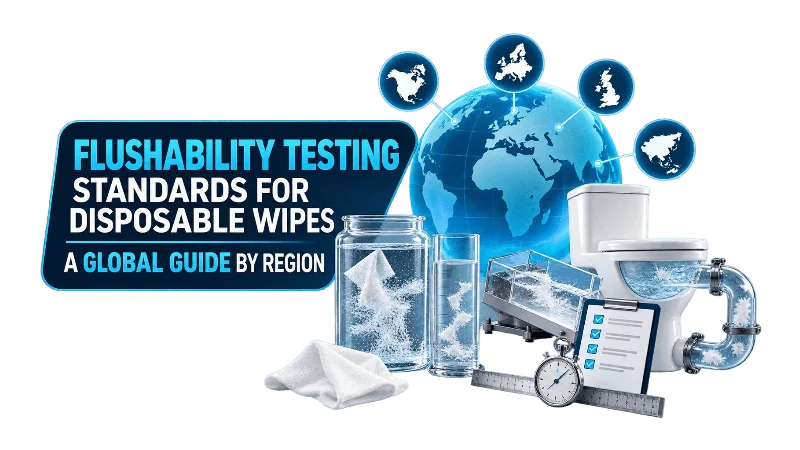
Understanding GD4, IWSFG, AS/NZS 5328 and Regional Requirements for Flushable Wipes
When a wet wipe is marketed as “flushable,” the claim means much more than simply being able to pass through a toilet.
A flushable wipe needs to be designed and evaluated for its interaction with toilets, household drain lines, wastewater conveyance systems and, depending on the applicable testing framework, wastewater treatment processes.
The challenge for manufacturers and private label brands is that flushability testing requirements are not identical in every market.
Different regions may reference different standards, industry guidelines, wastewater specifications or retailer requirements. A wipe that has been evaluated under one framework should therefore not automatically be assumed to satisfy every requirement in another market.
For manufacturers developing flushable wipes for international markets, understanding the differences between INDA/EDANA GD4, IWSFG flushability specifications and AS/NZS 5328 is an important part of product development.
In this guide, we explain the major flushability testing frameworks, how regional requirements differ, what manufacturers should consider during product development, and why testing the finished wet wipe is essential.
What Does “Flushable” Actually Mean?
A flushable wipe is designed to be disposed of through a toilet and wastewater system under the conditions defined by the applicable flushability framework.
However, flushability is not determined by a single characteristic such as whether the wipe can be flushed away.
A properly developed flushable wipe needs to balance two seemingly different requirements:
- It must have sufficient strength for its intended use.
- It must lose strength and disintegrate appropriately after flushing.
- It should be compatible with household drain lines and wastewater conveyance systems.
- It should behave appropriately during wastewater treatment.
- It should meet applicable environmental and labeling requirements.
This is why flushability is a finished-product performance characteristic rather than simply a raw-material characteristic.
For example, selecting a cellulose-based substrate does not automatically make a wet wipe flushable. Fiber composition, bonding technology, wet strength, basis weight, formulation, converting process and product aging can all affect the performance of the finished product.
INDA/EDANA’s flushability framework evaluates multiple aspects of a disposable nonwoven product rather than relying only on whether a wipe breaks apart in water.[1][2]
Why Do Flushability Standards Vary by Region?
There is no single testing framework that should simply be assumed to apply identically to every country.
One reason is that wastewater infrastructure varies significantly between markets.
Different regions may have differences in:
- Household plumbing systems
- Drain-line configurations
- Sewer networks
- Pumping equipment
- Wastewater treatment systems
- Septic systems
- Local disposal practices
The regulatory and industry environment also differs.
Some requirements are developed as industry guidelines, while others may be incorporated into national standards, wastewater utility requirements, retailer specifications or local regulations.
This creates an important distinction:
Passing a flushability test is not necessarily the same as having a universal legal right to make a “flushable” claim in every market.
For this reason, brands should identify the target market and applicable claim requirements before selecting a testing program.
Major Flushability Testing Frameworks
Several frameworks are frequently discussed in the flushable wipes industry.
The most important ones for international manufacturers include:
| Framework | Main Relevance | General Focus |
|---|---|---|
| INDA/EDANA GD4 | International industry reference | Flushability assessment and labeling |
| IWSFG PAS | International wastewater-sector framework | Compatibility with wastewater infrastructure |
| AS/NZS 5328 | Australia and New Zealand | Flushable product requirements and test methods |
| Local or retailer requirements | Market- or customer-specific | Additional testing, claims or labeling requirements |
These frameworks have overlapping technical objectives, but they should not automatically be treated as interchangeable.
INDA/EDANA GD4 Flushability Testing
What Is GD4?
GD4 refers to the Fourth Edition of the Guidelines for Assessing the Flushability of Disposable Nonwoven Products, developed through collaboration between INDA and EDANA.[1]
The framework is intended to help manufacturers and brand owners evaluate whether disposable nonwoven products are appropriate for disposal through the toilet.
GD4 is particularly relevant to products such as:
- Flushable wet wipes
- Moist toilet tissue
- Personal hygiene wipes
- Other disposable nonwoven products intended for flushing
What Does GD4 Evaluate?
The GD4 framework includes multiple assessment areas related to the performance of a product after flushing.
These include considerations related to:
- Toilet and drain-line clearance
- Disintegration
- Settling
- Wastewater transport
- Pump performance
- Septic systems
- Municipal wastewater treatment
The framework therefore goes beyond a simple “does the wipe dissolve in water?” assessment.
For manufacturers, this is an important distinction. A wipe that breaks apart in a laboratory container may still require additional evaluation of its behavior in wastewater infrastructure.
Why Is GD4 Important for Manufacturers?
GD4 provides a structured industry framework that can be incorporated into product development and testing programs.
However, manufacturers should distinguish between:
GD4 testing
and
legal or market-specific requirements.
GD4 should not automatically be interpreted as a universal regulatory approval applicable to every country.
IWSFG Flushability Specifications
The International Water Services Flushability Group (IWSFG) approaches flushability from a wastewater-services perspective.
The IWSFG has published a series of Publicly Available Specifications covering criteria and test methods for products intended to be flushed down toilets.[3][4][5]
The publicly available framework includes:
- IWSFG PAS 1 — Criteria for Recognition as a Flushable Product
- IWSFG PAS 2 — Terms and Definitions for Determination of Flushability
- IWSFG PAS 3 — Disintegration Test Methods — Slosh Box
The Five IWSFG Flushability Criteria
IWSFG PAS 1 identifies five key criteria for recognition as a flushable product:[3]
- Environmental and public health protection
- Toilet and drain-line clearance
- Disintegration
- Settling
- Biodisintegration
This is an important concept for product developers.
A wipe can disintegrate relatively quickly in a laboratory water test but still require further evaluation for other aspects of wastewater-system compatibility.
Is IWSFG a Mandatory Regulation?
The IWSFG specifications are a voluntary framework rather than universal legislation automatically applicable in every market.[3]
They are intended to provide a technical basis for assessing flushability and are particularly relevant to wastewater utilities and manufacturers.
Therefore, brands should distinguish between:
meeting an IWSFG specification
and
meeting the legal or market-specific requirements of a particular country.
AS/NZS 5328 for Australia and New Zealand
For companies developing flushable wipes for Australia and New Zealand, AS/NZS 5328 — Flushable Products is an important standard to understand.[6]
The standard establishes criteria for determining whether products can be classified as flushable and includes test methods and labeling requirements.
This makes AS/NZS 5328 particularly relevant for brands targeting:
- Australia
- New Zealand
- Australian and New Zealand retail channels
- Private label products intended for these markets
Why Should Manufacturers Review AS/NZS 5328 Separately?
A manufacturer should not automatically assume that a flushability test performed under another framework establishes compliance with AS/NZS 5328.
The appropriate approach is to identify the target market first and then determine which standard, testing methodology and claim requirements apply.
This is especially important when a product is being developed simultaneously for several international markets.
Flushability Testing in the United States
In the United States, INDA/EDANA GD4 is an important industry reference for evaluating the flushability of disposable nonwoven products.[1]
However, manufacturers and brands should also consider:
- Applicable federal requirements
- State and local requirements
- Wastewater utility expectations
- Retailer specifications
- Packaging and disposal claims
Therefore, a U.S. product development project should not be reduced to the question:
“Does the product pass GD4?”
A better question is:
“What flushability, labeling and market requirements apply to this product and claim?”
This approach helps manufacturers avoid treating an industry guideline as though it were a universal legal requirement.
Flushability Requirements in Europe
GD4 is also relevant to the European nonwoven industry because EDANA was involved in developing the guidelines.[2]
However, European brands should still review the requirements applicable to the specific country, product category and marketing claim.
A private label project may involve additional requirements from:
- National authorities
- Wastewater organizations
- Retailers
- Certification programs
- Customer specifications
The same principle applies:
A test framework can provide technical evidence, but the applicable market requirements still need to be reviewed separately.
Flushability Requirements in the UK
The UK requires particular attention because the industry and regulatory landscape around flushable wipes has evolved.
Water UK previously published the Fine to Flush specification, formally identified as WIS 4-02-06.[7]
However, the specification has subsequently been archived by the Water UK Standards Board.
Therefore, manufacturers should not present Fine to Flush as a current universal UK regulatory requirement.
For UK projects, brands should verify the latest applicable legislation, industry requirements, wastewater guidance and customer specifications before making a flushability claim.
This is a good example of why manufacturers should regularly review market requirements rather than relying on an older test program or certification.
GD4 vs IWSFG vs AS/NZS 5328
Although these frameworks share many technical objectives, they are not identical.
| Topic | INDA/EDANA GD4 | IWSFG PAS | AS/NZS 5328 |
|---|---|---|---|
| Primary focus | Flushability assessment for disposable nonwovens | Wastewater-system compatibility | Flushable product requirements |
| Geographic relevance | International industry use | International wastewater-sector framework | Australia & New Zealand |
| Toilet/drain-line considerations | Yes | Yes | Yes |
| Disintegration | Yes | Yes | Yes |
| Settling | Yes | Yes | Yes |
| Wastewater considerations | Yes | Yes | Yes |
| Labeling considerations | Yes | Yes | Yes |
| Framework type | Industry guideline | Voluntary specification / Code of Practice | National standard |
| Automatically interchangeable? | No | No | No |
The key point is not that one framework is universally “better.”
The key point is:
The applicable testing framework should be selected according to the target market, product claim and customer requirements.
Why Passing One Flushability Test Does Not Automatically Mean Global Compliance
This is one of the most common misunderstandings in international flushable wipes development.
Imagine that a wipe passes a particular flushability assessment.
That result provides valuable technical evidence.
But it does not necessarily mean that the product automatically satisfies:
- Every country’s requirements
- Every wastewater authority’s requirements
- Every retailer’s specification
- Every labeling requirement
- Every applicable national standard
There are several reasons.
Test Methods Can Differ
Two frameworks may evaluate similar characteristics using different test procedures.
Acceptance Criteria Can Differ
The same performance characteristic may have different acceptance thresholds or evaluation conditions.
Labeling Requirements Can Differ
A product’s technical performance and its packaging claim are related but separate considerations.
Regulations and Industry Requirements Can Change
Flushability requirements continue to evolve as governments, wastewater utilities and industry organizations review the impact of wipes on wastewater systems.
Retailers May Have Additional Requirements
Large retailers and private label customers may require testing beyond the minimum market requirements.
For international private label projects, this is why the testing strategy should be established before finalizing the substrate and product specification.
What Materials Are Used for Flushable Wipes?
Flushable wipes are commonly developed using cellulose-based or other dispersible nonwoven substrates.
Potential materials may include:
- Wood pulp
- Viscose
- Cellulose-based fibers
- Lyocell
- Cellulose fiber blends
- Other specially engineered flushable nonwoven materials
However:
Fiber composition alone does not determine whether a finished wet wipe is flushable.
For example, simply describing a wipe as “100% viscose” does not automatically establish that the finished product is suitable for flushing.
The final performance can be influenced by:
- Fiber type
- Fiber length
- Basis weight
- Fiber bonding
- Wet strength
- Dry strength
- Binder system
- Lotion formulation
- Sheet size
- Embossing
- Folding method
- Manufacturing process
- Product aging
The finished wet wipe should therefore be evaluated rather than relying only on the technical specification of the dry substrate.
Wet Strength vs. Flushability: The Core Product Development Challenge
One of the biggest technical challenges in flushable wipes development is balancing in-use strength with post-flush disintegration.
Consumers expect a wipe to:
- Feel strong
- Remain intact during use
- Have adequate wet strength
- Resist tearing
Wastewater systems, however, require the product to break down appropriately after disposal.
This creates an important product-development principle:
A flushable wipe should be strong enough for its intended use, but designed to lose structural integrity appropriately after flushing.
A product that is too weak may fail during use.
A product that remains too strong after flushing may create problems in wastewater systems.
Successful flushable wipe development therefore requires optimization rather than simply reducing the strength of the substrate.
Does the Wet Wipe Formula Affect Flushability?
Yes.
The substrate should not always be evaluated independently from the finished wet wipe.
A finished product contains more than the nonwoven substrate.
It may include:
- Water
- Surfactants
- Humectants
- Preservatives
- pH adjusters
- Conditioning ingredients
- Other formulation components
The interaction between the substrate and the lotion can affect the physical characteristics of the finished product.
For this reason, a substrate that performs well during initial development should be evaluated again as part of the finished wet wipe.
This is particularly important when developing private label products because the customer may change:
- Lotion formula
- Fragrance
- Preservative system
- pH
- Substrate GSM
- Fiber composition
Any significant formulation or substrate change can potentially affect final product performance.
Why Sample Age Matters in Flushability Testing
Flushability testing should also take product aging into consideration.
The physical properties of a wet wipe can change during storage because the liquid formulation remains in contact with the substrate for an extended period.
Potential changes may involve:
- Fiber structure
- Wet strength
- Tensile properties
- Disintegration behavior
- Interaction between formulation and substrate
The IWSFG framework recognizes the importance of product age and test reproducibility in flushability evaluation.[3]
For this reason, a development program should define the appropriate testing point rather than relying only on a freshly manufactured sample.
This is particularly important for commercial products that may remain in warehouses, distribution centers and retail environments for months before use.
How to Develop a Flushable Wipe for Different Markets
A practical development process can be organized into seven steps.
Step 1: Define the Target Market
Start with the destination market.
For example:
- United States
- Canada
- Australia
- New Zealand
- United Kingdom
- European markets
- Other international markets
Do not start with the assumption that one test program will automatically cover every destination.
Step 2: Identify the Applicable Framework
Determine which standards, guidelines and customer requirements are relevant.
This may include:
- INDA/EDANA GD4
- IWSFG specifications
- AS/NZS 5328
- Local wastewater requirements
- Retailer-specific specifications
Step 3: Select the Substrate
Evaluate:
- Fiber composition
- GSM
- Wet strength
- Dry strength
- Absorbency
- Disintegration behavior
- Manufacturing compatibility
The goal is to develop a substrate that balances consumer performance and wastewater compatibility.
Step 4: Develop the Formula
The lotion should be developed together with the substrate.
Formula changes should be reviewed for their potential impact on:
- Wet strength
- Product stability
- Disintegration
- Fiber interaction
- Finished-product performance
Step 5: Test the Finished Product
This is critical.
Testing the dry substrate alone is not sufficient to substantiate the flushability claim of the finished wet wipe.
The final product should be tested using the applicable methodology and specifications for the intended market.
Step 6: Review Packaging and Claims
A technically compliant product can still have packaging or disposal-claim issues.
Before commercial production, review:
- Flushable claim wording
- Disposal instructions
- Symbols
- Packaging artwork
- Required labeling
- Customer-specific claim requirements
Step 7: Establish Change Control
Flushability should be considered when making significant product changes.
For example:
- Changing the nonwoven supplier
- Changing fiber composition
- Changing GSM
- Changing the lotion
- Changing the binder
- Changing sheet size
- Changing embossing
- Changing folding
- Changing manufacturing parameters
A new specification review or additional testing may be appropriate depending on the nature of the change and the requirements of the target market.
Flushability Testing Checklist for Private Label Brands
Before launching a private label flushable wipe, brands should consider the following checklist:
☐ Target market identified
☐ Applicable flushability framework identified
☐ Customer/retailer requirements confirmed
☐ Nonwoven substrate specification confirmed
☐ Fiber composition confirmed
☐ GSM and physical properties confirmed
☐ Finished wipe formula confirmed
☐ Appropriate flushability testing completed
☐ Test laboratory and test methodology documented
☐ Test report available
☐ Packaging and disposal claims reviewed
☐ Labeling requirements reviewed
☐ Product change-control process established
This approach can help reduce the risk of discovering a flushability issue after the product has already entered commercial production.
Frequently Asked Questions
What Is Flushability Testing?
Flushability testing evaluates whether a disposable product is suitable for disposal through a toilet under the conditions and criteria defined by the applicable testing framework.
It can include assessment of toilet clearance, drain-line behavior, disintegration, settling, wastewater transport and treatment-related performance.
What Is GD4 Flushability Testing?
GD4 is the Fourth Edition of the Guidelines for Assessing the Flushability of Disposable Nonwoven Products, developed by INDA and EDANA.[1]
It provides a framework for assessing flushability and includes multiple tests related to wastewater infrastructure.
What Is the IWSFG Flushability Standard?
IWSFG has developed a set of Publicly Available Specifications covering criteria and test methods for products intended to be flushed.
Its framework addresses environmental and public health protection, toilet and drain-line clearance, disintegration, settling and biodisintegration.[3]
Is GD4 a Mandatory Legal Standard?
GD4 is an industry guideline rather than a universal law applicable to every market.
However, it may be referenced by manufacturers, brands and retailers when evaluating flushable wipes.[1]
Applicable laws, standards and customer requirements should always be checked for the target market.
Is IWSFG the Same as GD4?
No.
They address similar flushability objectives but are different frameworks developed by different organizations and with differences in test methods and criteria.
They should not automatically be treated as interchangeable.
What Is AS/NZS 5328?
AS/NZS 5328 is the Flushable Products standard for Australia and New Zealand.
It establishes criteria for determining whether products can be classified as flushable and includes flushability test methods and labeling requirements.[6]
Can a Wipe Pass GD4 and Still Require Additional Testing?
Yes.
Additional testing may be appropriate when entering a market with different requirements or when a customer or retailer specifies an additional testing framework.
The applicable requirements should be determined before commercialization.
Are 100% Viscose Wipes Automatically Flushable?
No.
Fiber composition alone does not establish flushability.
The finished wipe’s structure, wet strength, formulation and other characteristics must be evaluated against the applicable requirements.
Does the Wet Wipe Formula Affect Flushability?
It can.
The lotion remains in contact with the substrate and may influence the physical properties of the finished wipe.
Therefore, the finished product should be considered during flushability development and testing.
How Long Should Flushable Wipes Be Aged Before Testing?
The appropriate conditioning or aging period depends on the applicable testing framework and project requirements.
Manufacturers should follow the relevant test methodology rather than choosing an arbitrary aging period.
Can Baby Wipes Be Flushable?
Baby wipes and flushable wipes are not automatically the same product category.
A baby wipe should only be marketed as flushable when it has been specifically designed, evaluated and substantiated for the applicable flushability requirements.
What Documents Should a Flushable Wipes Manufacturer Provide?
Depending on the project and target market, a manufacturer may provide:
- Product specification
- Raw material specification
- Finished product specification
- Flushability test report
- Technical data sheet
- Certificate of Analysis where applicable
- Formula information or ingredient documentation where appropriate
- Packaging specifications
- Labeling and claim documentation
The exact documentation package should be agreed with the brand or retailer.
Final Thoughts: Flushability Is a Market-Specific Product Claim
Flushability is not simply a property of a particular fiber.
It is a finished-product performance claim that needs to be evaluated against the applicable technical and market requirements.
GD4, IWSFG and AS/NZS 5328 all provide important frameworks for understanding flushability, but they should not automatically be considered interchangeable.
For brands developing flushable wipes for international markets, the most practical approach is:
Target Market → Applicable Requirements → Substrate → Formula → Finished Product Testing → Labeling → Commercial Production
Starting with the target market can help manufacturers avoid developing a product that performs well under one testing framework but requires additional work to satisfy another market’s requirements.
At Qimei, we support private label and OEM flushable wipes development from substrate selection and product formulation through pilot production and third-party testing coordination.
If you are developing a flushable wipe for the U.S., Australia, New Zealand, Europe, UK or another international market, our technical team can help evaluate the appropriate development and testing route for your target market.
Looking for a private label flushable wipes manufacturer? Contact Qimei to discuss your product specification, target market and testing requirements.
REFERENCES CITED
INDA.Guidelines for Assessing the Flushability of Disposable Nonwoven Products — Edition 4 (GD4).Official document
EDANA.Flushability Test Methods, Guidelines & Code of Practice.Official EDANA/INDA resource
IWSFG.PAS 1 — Criteria for Recognition as a Flushable Product.Official IWSFG document
IWSFG.PAS 2 — Terms and Definitions for Determination of Flushability.IWSFG Flushability Specifications
IWSFG.PAS 3 — Disintegration Test Methods – Slosh Box.IWSFG Flushability Specifications
Standards Australia / Standards New Zealand.AS/NZS 5328 — Flushable Products.Standards Australia official information
Water UK Standards Board.WIS 4-02-06 — Fine to Flush.
Archived.Official Water UK Standards Board document
EDANA.EDANA Position on Water UK’s Flushability Specification and “Fine to Flush” Initiative.Official EDANA position paper