 Meet Qimei at PLMA Chicago 2026 · November 15–17, 2026 · Booth #H3029
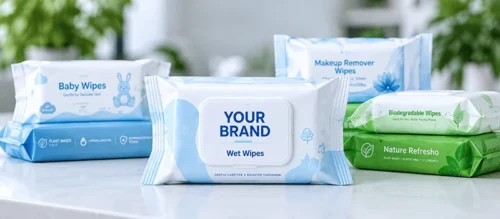


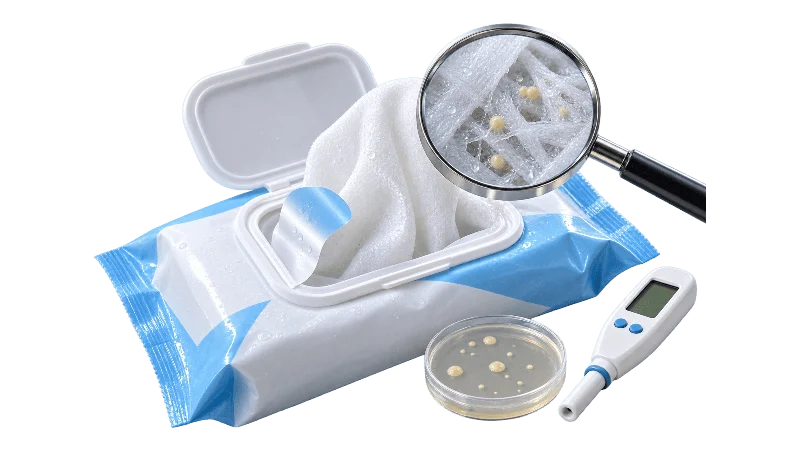
Wet wipes contain a large amount of water and are often stored for two or three years before use. Once the package is opened, the product may also be repeatedly exposed to air, fingers and microorganisms from the surrounding environment.
This makes preservation one of the most technically challenging parts of wet wipes formulation.
A preservative that performs well in a bottle of liquid may not provide the same protection after the lotion is added to nonwoven fabric and sealed inside a soft pack. The fabric can absorb part of the preservative, the lotion may not be distributed evenly, and the packaging may allow moisture or air to enter over time.
The challenge can be even greater for some flushable wipes. Their cellulose-rich, highly absorbent and dispersible substrates may retain moisture differently from conventional polyester-containing nonwoven fabrics. If the preservative system, pH, packaging or manufacturing controls are inadequate, localized mold growth may develop.
However, flushable wipes are not automatically unsafe or guaranteed to develop mold. The risk depends on the complete product system and must be controlled through proper formulation, manufacturing hygiene, packaging and finished-product testing.
Why Do Wet Wipes Need a Preservative System?
Most wet wipes lotions are primarily water. Water creates an environment in which bacteria, yeast and mold may grow if other conditions are favorable.
The formula may also contain ingredients that increase preservation difficulty, including:
- Botanical extracts
- Mild surfactants
- Humectants
- Emollients
- Proteins or amino-acid-based ingredients
- Fragrance components
- Naturally derived ingredients
- Organic residues from raw materials
Microorganisms can enter the product through:
- Purified water
- Formula ingredients
- Nonwoven fabric
- Mixing tanks
- Transfer pipes
- Production equipment
- Packaging components
- Factory air
- Production operators
- Consumer use
An effective preservative system helps control microorganisms that may be introduced during manufacturing or after the package is opened.
Without adequate preservation, a wet wipe may develop:
- Visible mold spots
- Unpleasant odors
- Discoloration
- Gas or package swelling
- Lotion separation
- Slime
- Changes in pH
- Reduced product performance
- Potential consumer safety risks
Preservatives are only one part of microbial control. They cannot compensate for contaminated water, dirty equipment or poorly sealed packaging.
Why Is a Finished Wet Wipe Harder to Preserve Than Bulk Lotion?
A wet wipe is not simply a liquid product. It is a combination of lotion, nonwoven substrate, packaging and production process.
Each component can affect preservative performance.
1. The Fabric Can Reduce Preservative Availability
When the lotion contacts the nonwoven fabric, some preservative ingredients may be absorbed or adsorbed by the fibers.
The amount remaining in the liquid phase may therefore be lower than the amount originally added to the mixing tank.
The level of interaction depends on:
- Fiber composition
- Fabric GSM
- Surface area
- Fabric density
- Embossing
- Preservative chemistry
- Surfactants
- pH
- Lotion loading
This means that a formula passing a challenge test as bulk lotion may not perform identically after it is applied to the final substrate.
2. Lotion Distribution May Be Uneven
The top, middle and bottom wipes in a package may not contain exactly the same amount of lotion.
Uneven distribution may be caused by:
- Inaccurate liquid dosing
- Fabric absorbency
- Pack orientation
- Storage position
- Gravity
- Wipe compression
- Differences in fiber structure
- Transportation vibration
Areas containing less preservative solution may be more vulnerable to contamination. Areas with excess free liquid may also behave differently from properly saturated wipes.
3. The Fabric Creates a Large Surface Area
A stack of wet wipes provides a much larger contact surface than a bottle of lotion.
The lotion spreads across:
- Individual fibers
- Spaces between fibers
- Folded surfaces
- Cut edges
- The dispensing opening
- The inside of the package
This creates multiple locations where microorganisms may become trapped or grow if the preservation system is inadequate.
4. Testing the Liquid Alone May Miss Product Risks
Bulk-lotion testing is useful during formula development, but it does not fully represent the finished product.
The final wet wipes should be assessed with:
- The intended nonwoven fabric
- The approved lotion loading
- The final fold type
- The production process
- The actual packaging
- The intended storage conditions
Any major change to the fabric, formula or package may affect preservation performance.
Why Can Flushable Wipes Be More Prone to Mold?
Flushable wipes are not always more likely to develop mold. However, certain characteristics of flushable substrates can make preservation more demanding than for conventional nonwoven wipes containing a high proportion of polyester.
1. Flushable Wipes Commonly Use Cellulose-Rich Materials
Flushable wipes are often made from materials such as:
- Wood pulp
- Short cellulose fibers
- Viscose
- Lyocell
- Other dispersible plant-derived fibers
These fibers are designed to absorb water and eventually lose strength or disperse under appropriate flushing conditions.
Conventional wet wipes may contain polyester, which is a synthetic and relatively inert fiber. Polyester does not naturally absorb water into its fiber structure in the same way as cellulose-based fibers.
A cellulose-rich flushable wipe may therefore hold and distribute moisture differently from a conventional viscose-polyester wipe.
2. Cellulose Fibers Are Highly Hydrophilic
Hydrophilic fibers attract and retain water.
This provides advantages during use because the wipe can hold enough lotion while remaining soft. However, it also means that moisture may remain closely associated with the fiber network.
If the preservative does not reach every area evenly, small localized zones may receive inadequate protection.
Mold growth may first appear:
- Along cut edges
- Near the package opening
- On the top wipe
- In folded areas
- In areas with uneven lotion
- In parts of the pack exposed to more air
3. Some Molds Can Colonize Cellulose-Based Materials
Cellulose itself does not automatically cause mold. Properly preserved cellulose-based wipes can remain stable throughout their shelf life.
However, certain molds can colonize cellulosic materials when sufficient moisture, oxygen and nutrients are available.
Potential nutrients may come from:
- Natural impurities in the substrate
- Residual processing materials
- Botanical extracts
- Surfactants
- Fragrance ingredients
- Other organic components in the lotion
The combination of a biodegradable substrate, high moisture and inadequate preservation may therefore create conditions that support visible mold growth.
4. Dispersible Structures May Have Different Porosity
Many flushable substrates are designed with short fibers or specialized bonding structures so they can lose strength after flushing.
Their porosity, liquid movement and fiber arrangement may differ from conventional spunlace fabrics.
This can influence:
- Lotion distribution
- Preservative contact
- Air spaces within the stack
- Moisture migration
- Wipe compression
- Packaging performance
The preservative system should therefore be validated with the actual flushable substrate rather than transferred directly from a conventional wet wipes formula.
5. Flushable Products Often Use Mild Formulas
Flushable wipes are frequently intended for personal hygiene, intimate care, baby care or moist toilet tissue applications.
Brands may request:
- Mild ingredients
- Fragrance-free formulas
- Low-irritation preservatives
- Short ingredient lists
- Naturally positioned ingredients
- Sensitive-skin claims
- Alcohol-free formulations
These requirements reduce the number of suitable preservation options and can make formulation more difficult.
6. Preservatives Must Not Damage Dispersibility
The formula must preserve the product without negatively affecting its intended flushability performance.
Changes in:
- pH
- Salt concentration
- Surfactants
- Preservative blends
- Lotion loading
may influence substrate strength, binder performance or dispersibility.
The formulator must therefore balance microbial protection, skin compatibility and flushability rather than optimizing only one property.
How Does Nonwoven Material Affect Preservative Performance?
Different nonwoven materials interact with lotions in different ways.
1. Viscose and Lyocell
Viscose and lyocell are regenerated cellulose fibers with good softness and absorbency.
They may retain more lotion than polyester-rich materials, but their interaction with preservatives and other formula ingredients must be evaluated in the finished product.
2. Wood Pulp
Wood pulp is commonly used in dispersible and flushable nonwoven materials.
It provides high absorbency and supports break-up performance, but its short fibers and cellulosic structure may influence liquid distribution and initial microbial load.
3. Polyester
Polyester provides wet strength and is less absorbent than cellulose-based fibers.
Because it is synthetic and relatively resistant to biological degradation, it may present fewer substrate-related nutrients for mold. However, polyester-containing wipes can still develop microbial contamination if the lotion or manufacturing process is not adequately controlled.
4. Bamboo-Derived Viscose
Many bamboo wet wipes use bamboo-derived viscose rather than untreated bamboo fibers.
Its preservation behavior is generally closer to other regenerated cellulose materials. The term “bamboo” does not remove the need for preservative efficacy testing.
5. Changing the Fabric Can Change the Test Result
A formula validated with a 50% viscose and 50% polyester substrate should not automatically be assumed suitable for:
- 100% viscose
- Wood-pulp flushable material
- Lyocell
- Bamboo-derived viscose
- A different GSM
- A different embossing pattern
- A different supplier
The new material may absorb the lotion or preservative differently.
How Do Formula Ingredients Influence Mold Risk?
The complete formula determines whether the preservative can remain effective.
1. Preservatives
Preservatives must provide appropriate protection against bacteria, yeast and mold.
Some systems offer strong antibacterial performance but weaker protection against fungi. A successful wet wipes preservative system often uses complementary ingredients to achieve broader protection.
Selection depends on:
- Product type
- Target market
- Formula pH
- Skin-contact area
- Consumer age
- Other ingredients
- Packaging
- Regulatory limits
- Intended claims
The lowest preservative concentration is not automatically the mildest or safest option if it fails to protect the product.
2. pH
Some preservatives work effectively only within a specific pH range.
If the formula pH is too high or changes during storage, the preservative system may lose part of its activity.
A stable pH range should be confirmed:
- In the bulk lotion
- After contact with the fabric
- During accelerated stability testing
- During real-time storage
- In the final package
The target pH must also remain suitable for the intended use and skin-contact area.
3. Surfactants and Solubilizers
Surfactants help remove soil and solubilize fragrance or oil-soluble ingredients.
However, they may also interact with preservatives and reduce the amount that remains microbiologically active.
Adding more surfactant does not always improve the product. The complete system must be evaluated together.
4. Botanical Extracts
Aloe vera, chamomile, calendula, green tea and other botanical extracts are popular in personal care wipes.
They can support marketing and skin-care positioning, but they may introduce:
- Additional organic matter
- Variable microbial quality
- Color changes
- Odor changes
- Preservation challenges
Extracts should be sourced from qualified suppliers and evaluated at the intended use level.
5. Fragrance
Fragrance components may interact with solubilizers, surfactants and preservatives.
Changing a fragrance after the formula passes testing may affect the product’s stability or preservation performance.
Each major fragrance change should receive a documented risk assessment.
6. Chelating Agents
Chelating agents bind metal ions and may improve formula stability. In some systems, they can also support preservative performance.
They are supporting ingredients, not replacements for a validated preservative system.
How Does Packaging Affect Wet Wipes Preservation?
Packaging protects the wipes from moisture loss, oxygen, contamination and repeated handling.
1. Seal Integrity
Weak or incomplete seals may allow:
- Air to enter
- Moisture to escape
- External contamination
- Fragrance loss
- Changes in lotion concentration
Seal quality depends on film structure, temperature, pressure, machine speed and seal-area cleanliness.
2. Resealable Labels
A resealable label must maintain adequate adhesion throughout the product’s use period.
If the label does not close properly, the top wipes may dry out and receive greater exposure to air and microorganisms.
3. Plastic Flip-Top Lids
Flip-top lids improve dispensing and help protect the opening, but they do not replace a reliable film seal or resealable label.
The lid, adhesive, opening size and film structure must work together.
4. Package Headspace
Mold requires oxygen. Excessive air inside the package or repeated air exchange after opening can support surface mold when preservation is inadequate.
This is one reason mold may appear first on the top wipe or around the package opening.
5. Film Barrier Properties
Packaging film should provide sufficient resistance to water-vapor and oxygen transmission for the intended shelf life.
A film structure selected only for low price may not provide adequate long-term protection.
How Can Manufacturing Conditions Introduce Contamination?
A strong preservative system cannot correct poor manufacturing hygiene.
1. Water Quality
Purified water should be produced, stored and transferred under controlled conditions.
The water system should be monitored and maintained to prevent biofilm or microbial contamination.
2. Raw Material Bioburden
Nonwoven fabric and formula ingredients are not necessarily sterile.
The manufacturer should control:
- Supplier qualification
- Storage conditions
- Packaging integrity
- Batch documentation
- Material handling
- Incoming microbial risk
Cellulose-rich and naturally derived materials may require particular attention to incoming bioburden.
3. Mixing Tanks and Transfer Lines
Residues in tanks, pipes, pumps or hoses can support microbial growth between batches.
Cleaning and sanitation procedures should define:
- Cleaning method
- Cleaning frequency
- Contact time
- Rinsing
- Inspection
- Documentation
- Corrective action
4. Production Environment
Wet wipes are commonly produced as non-sterile products, but environmental hygiene remains essential.
The factory should control:
- Personnel hygiene
- Equipment surfaces
- Air cleanliness
- Material movement
- Pest control
- Cleaning tools
- Waste removal
- Cross-contamination
5. Holding Time
Prepared lotion should not remain uncontrolled for an excessive period before filling.
Maximum holding time and storage conditions should be defined according to the formula and manufacturing process.
Why Is Mold Sometimes Found Only in Part of the Pack?
A contaminated pack does not always show mold on every wipe.
Localized mold can result from:
- Uneven preservative distribution
- Uneven lotion loading
- Greater oxygen exposure near the opening
- Contamination during dispensing
- A defective seal
- Localized substrate contamination
- Moisture migration
- Contact with equipment surfaces
- Pack damage during transportation
The absence of visible mold on other wipes does not prove that they are safe.
Microbial contamination may be present before it becomes visible. A pack showing mold, unusual odor, swelling, discoloration or slime should not be used.
Which Tests Help Confirm Wet Wipes Preservation?
Preservation should be supported by a combination of tests rather than one result.
1. Microbial Limits Testing
Microbial limits testing evaluates the microbiological quality of a sample at a specific time.
It may include:
- Total aerobic microbial count
- Yeast and mold count
- Tests for specified microorganisms
Passing microbial limits testing at production does not prove that the product will remain protected throughout its shelf life.
2. Preservative Efficacy or Challenge Testing
A challenge test deliberately introduces selected microorganisms and measures how effectively the product controls them over time.
Depending on the product classification and target market, manufacturers may use a suitable cosmetic or pharmacopoeial method.
For wet wipes, testing should consider the finished substrate-lotion system rather than relying only on bulk lotion.
3. Stability Testing
Stability testing monitors changes in:
- Appearance
- Odor
- Color
- pH
- Lotion distribution
- Fabric strength
- Packaging
- Seal integrity
- Label adhesion
- Preservative performance
Accelerated testing provides early information, while real-time testing supports the intended shelf life.
4. Packaging Compatibility Testing
The manufacturer should evaluate whether the formula interacts with:
- Packaging film
- Adhesive
- Resealable label
- Plastic lid
- Ink
- Canister
- Bucket
Changes in packaging may require additional compatibility and preservation review.
5. Flushability Testing
For flushable wipes, preservation testing and flushability testing serve different purposes.
A product can pass microbial testing but fail flushability testing. It can also pass dispersibility testing but fail preservation testing.
Both functions must be validated independently.
How Can Manufacturers Reduce Mold Risk in Flushable Wipes?
The most reliable approach combines formulation, manufacturing and packaging controls.
Control Initial Microbial Load
Manufacturers should begin with:
- Qualified raw material suppliers
- Controlled cellulose substrate storage
- Monitored purified water
- Clean equipment
- Hygienic production conditions
- Controlled material handling
A lower initial microbial load makes the preservative system more reliable.
Develop the Formula with the Actual Substrate
The preservative system should be developed using the intended flushable material, not only a conventional polyester-containing nonwoven.
This allows the formulator to evaluate:
- Preservative absorption
- Lotion distribution
- pH changes
- Fabric strength
- Dispersibility
- Finished-product microbial protection
Maintain a Stable pH
The formula should remain within the validated pH range throughout storage.
A suitable buffering system may help reduce pH drift, but it must remain compatible with skin use and substrate performance.
Avoid Unnecessary Formula Complexity
Every additional extract, fragrance or functional ingredient creates another possible interaction.
A shorter formula can be easier to preserve, but simplicity alone does not guarantee safety. Even water-rich minimalist wipes require validated microbial protection.
Optimize Lotion Loading
The wipe should contain enough lotion for performance without creating excessive free liquid or uneven saturation.
The manufacturer should confirm liquid distribution throughout the pack.
Use Appropriate Packaging
The final pack should provide:
- Reliable seals
- Adequate barrier performance
- Consistent label adhesion
- Hygienic dispensing
- Limited moisture loss
- Protection during transportation
Test the Finished Product
The final formula, substrate, lotion loading and packaging should be tested as one system.
If any major component changes, the manufacturer should conduct a risk assessment and determine which tests need to be repeated.
What Should Private Label Buyers Confirm Before Mass Production?
Private label buyers should not approve a formula based only on the ingredient list.
They should confirm:
- Complete nonwoven composition
- Whether the substrate is flushable or conventional
- Fabric GSM
- Wipe dimensions
- Lotion loading
- Formula pH range
- Preservative system
- Packaging structure
- Seal and closure design
- Shelf-life target
- Microbial limits testing
- Challenge testing
- Stability testing
- Packaging compatibility
- Flushability testing where applicable
- Change-control requirements
Important questions include:
- Was the preservative test performed on the lotion or the finished wipes?
- Was the actual production substrate used?
- Does the result cover the intended packaging?
- Has the pH remained stable during storage?
- What happens if the fabric supplier changes?
- Are botanical extracts included in the tested formula?
- Is yeast and mold protection included?
- How is the cellulose substrate stored before production?
- How is purified water monitored?
- Will a formula or fragrance change require retesting?
The approved sample, test sample and mass-production specification should describe the same product.
Frequently Asked Questions About Wet Wipes Preservation
1. Are Flushable Wipes Always More Likely to Develop Mold?
No. Properly formulated and manufactured flushable wipes can remain microbiologically stable throughout their intended shelf life.
However, cellulose-rich, absorbent and dispersible substrates may create additional preservation challenges, especially when combined with mild formulas, uneven lotion distribution or inadequate packaging.
2. Why Can Ordinary Polyester-Containing Wipes Be Easier to Preserve?
Polyester is synthetic, relatively inert and less absorbent than cellulose fibers. It may interact differently with water and preservatives.
However, polyester-containing wipes can still develop mold if the lotion, packaging or manufacturing process is not adequately controlled.
3. Can Wet Wipes Be Made Without Preservatives?
Some products may use a self-preserving formulation or alternative microbial-control strategy.
However, “preservative-free” does not mean testing can be skipped. The finished product must still demonstrate adequate protection throughout its shelf life and use period.
4. Does a Simple Water-Based Formula Need Preservation?
Usually, yes. High water content creates microbial risk even when the ingredient list is short.
Minimalist formulas may be difficult to preserve because they offer fewer supporting mechanisms and are often expected to meet sensitive-skin requirements.
5. Is Visible Mold the First Sign of Contamination?
Not necessarily. Microorganisms may be present before mold becomes visible.
Changes in odor, color, pH, package pressure or lotion appearance may also indicate a problem.
6. Can More Preservative Solve Every Mold Problem?
No. Increasing preservative concentration cannot correct contaminated water, dirty equipment, high raw material bioburden or leaking packaging.
Preservative levels must also remain within applicable regulatory and safety limits.
7. Should the Formula Be Retested If the Nonwoven Fabric Changes?
Yes. A different fiber composition, GSM, embossing pattern or supplier may change preservative availability and lotion distribution.
The manufacturer should complete a risk assessment and determine whether challenge, stability or compatibility testing needs to be repeated.
8. Does Passing a Challenge Test Guarantee Every Batch Will Be Safe?
A passed challenge test supports the tested formula, substrate, process and packaging.
Routine manufacturing controls, microbial limits testing, sanitation and batch traceability are still required.
Final Thoughts
Wet wipes are difficult to preserve because they combine water, a large nonwoven surface area, repeated consumer exposure and packaging that must retain moisture for an extended shelf life.
The preservation challenge is not controlled by one ingredient alone. It depends on the interaction between:
- Purified water
- Raw material bioburden
- Preservatives
- Formula pH
- Surfactants
- Botanical extracts
- Nonwoven fibers
- Lotion loading
- Packaging
- Manufacturing hygiene
Some flushable wipes can be more susceptible to mold when their cellulose-rich, hydrophilic and dispersible substrates are combined with inadequate preservation or uneven lotion distribution. This does not mean flushable materials are inherently unsafe. It means the formula must be developed and tested with the actual substrate and final package.
QIMEI HYGIENE supports customized wet wipes formulation, substrate selection, packaging development and testing coordination. Our team can evaluate conventional and flushable wet wipes as complete product systems before mass production.
Looking for the right nonwoven fabric for your wet wipes? Contact QIMEI to discuss your product requirements.