 Meet Qimei at PLMA Chicago 2026 · November 15–17, 2026 · Booth #H3029





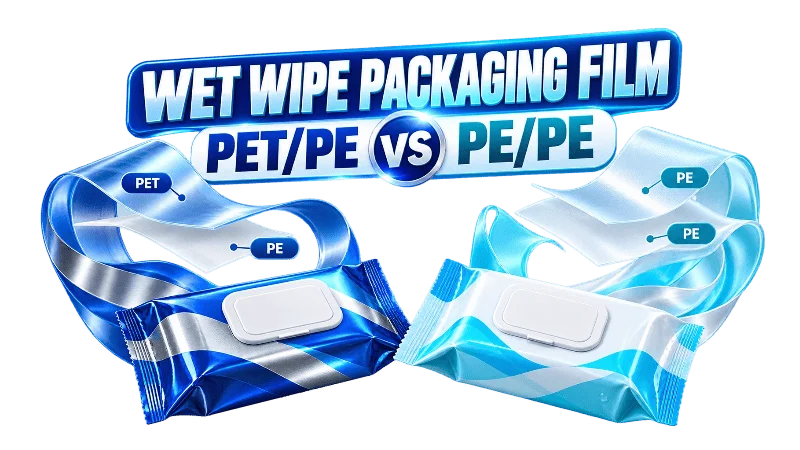
Wet wipe packaging is often discussed after the formula, nonwoven and wipe size have been selected. That is a mistake.
The packaging film protects the wipes during storage and transport. It affects how the pack looks on shelf. It also affects sealing performance, moisture retention and the recyclability conversation around the finished product.
For private label wet wipes, two structures are often compared: PET/PE and PE/PE.
PET means polyethylene terephthalate. PE means polyethylene. In simple terms, PET/PE is a laminate that combines PET and PE layers. PE/PE is an all-polyethylene or predominantly polyethylene structure. However, these names do not tell the whole story. Film thickness, resin grade, orientation, ink, adhesive, closure and pack format all influence the finished result. [4][5]
This guide explains the practical differences that brand owners, importers and wet wipes suppliers should review before approving printed film.
PET/PE and PE/PE Are Not Complete Film Specifications
A film description such as “PET/PE” is only a starting point. It does not confirm the thickness of each layer, the sealing layer, the printing method, the adhesive system or the barrier performance.
The same is true for PE/PE. One PE/PE structure may use an oriented PE outer web to improve stiffness and handling. Another may use different PE grades in a coextruded film. They can perform very differently on a wet wipes production line. [5]
For this reason, buyers should not ask only, “Is this PET/PE or PE/PE?” They should also ask:
- What are the exact film layers and thicknesses?
- Which layer is printed?
- What is the water-vapor transmission rate?
- What seal-strength target is required?
- Is the structure suitable for the planned lid or resealable label?
- Has the finished pack been tested with the selected formula and wipe stack?
- Is a recyclability claim appropriate in the target market?
The right structure is the one that protects the actual product and fits the brand’s sales market. It is not automatically the structure with the lowest film cost.
What Does PET/PE Usually Offer?
In a typical PET/PE laminate, PET is used as the outer layer and PE is used as the inner or sealing layer. PET films are widely used in packaging applications because they can provide good dimensional stability and can be surface-treated to support printing and lamination. [6]
For branded wet wipes, this can be useful when the pack requires sharp graphics, a smooth surface and stable performance during printing and converting.
PET/PE is often considered when a brand wants:
- A familiar laminate structure
- Strong visual presentation for retail shelves
- Good print and lamination performance
- A stable outer layer for high-quality artwork
- A PE sealing layer designed for the selected pack format
This does not mean PET/PE is always better. The final performance depends on the full material specification.
A pack may look premium in a flat film sample but still have problems after it is filled with moist wipes. The formula, lotion loading, fold type and stack height can change how the package behaves. A wet wipes manufacturer should therefore test the finished pack, not only the unconverted film.
What Does PE/PE Usually Offer?
PE/PE packaging is generally developed to reduce the use of mixed polymer families in the flexible package. CEFLEX design guidance gives preference to mono-PE and mono-PP structures over multilayer, multi-material structures when the goal is to improve recycling compatibility. [4]
Modern PE-based films can include oriented PE, such as machine-direction-oriented PE, or specially designed PE resins. These materials can help an all-PE structure achieve more stiffness, toughness or handling performance than a basic PE film alone. [5]
For private label projects, a PE/PE structure may be considered when the brand is working toward a PE-based package design and wants to assess the packaging against the collection and recycling systems in its destination market.
Potential reasons to explore PE/PE include:
- A preference for a predominantly PE structure
- A sustainability-led packaging brief
- A need to review mono-material design options
- A desire to reduce material-family complexity in the laminate
- A long-term packaging redesign project
However, “PE/PE” should not be treated as a guarantee that a pack is recyclable everywhere. Collection systems, sorting capability, recycling infrastructure, inks, adhesives, labels and local rules all matter. CEFLEX describes mono-material design as a preferred direction, but its guidelines are design guidance rather than a universal recycling guarantee. [3][4]
Moisture Protection Must Be Measured, Not Assumed
The main job of a wet wipe pack is to keep the wipes in the right condition until the consumer opens them.
A film structure should help the product retain moisture. But it is not enough to assume that PET/PE or PE/PE will meet this need based on the material name alone.
Water-vapor transmission rate, often called WVTR, is a key measurement when comparing flexible packaging films. ASTM F1249 sets out a method for measuring water-vapor transmission through plastic film and sheeting using a modulated infrared sensor. Test conditions must be stated because temperature and relative humidity affect the result. [1]
For a wet wipe project, ask the converter or wet wipes supplier to provide:
- WVTR results and test conditions
- Total film thickness and layer structure
- Finished-pack moisture-retention data where available
- Storage or transport test results
- Results from packs with the intended closure
This is especially important for large-count baby wipes packs, travel packs and products sold in hot or humid markets. A formula may remain stable in a laboratory bottle but lose moisture differently once it is loaded into a finished pack.
Wet wipes raw material also matters. A bulky nonwoven stack may create more pressure against the seals. A heavy lotion loading can affect how the pack feels and performs. Packaging, formula and substrate should be approved as one system.
Seal Strength Is Just as Important as Film Type
A wet wipe pack can have an attractive print surface and an acceptable barrier result, yet still fail if the seals are weak or inconsistent.
Seal strength measures the force needed to separate the sealed materials. ASTM F88/F88M provides a test method for measuring the seal strength of flexible barrier materials. ASTM F2029 provides procedures for making laboratory heat seals when evaluating heat sealability by seal strength. [2][7]
For OEM wet wipes projects, the buyer should confirm that the film works with the planned filling and packing process. A good film structure must be compatible with the machine settings, sealing temperature, dwell time and production speed.
Before bulk wet wipes manufacturing, test the complete pack for:
- Side-seal and end-seal integrity
- Leakage after compression
- Seal appearance
- Pack opening and resealing performance
- Wipe dispensing from the first sheet to the last
- Moisture retention after storage
- Carton packing and transport resistance
The test should use the final wipe material, final formula, target pack count and intended closure. A small change in pack count or wipe GSM can change the pressure on the seals.
Printing, Shelf Appearance and Pack Feel
Packaging is part of the consumer experience. This is especially true for baby wipes, personal care wipes and other products bought directly from retail shelves.
PET can be selected as a print carrier because PET films are available with surfaces designed to improve the adhesion of inks, adhesives and polyethylene in packaging laminations. [6] This makes PET/PE a familiar option for projects where brand presentation is the first priority.
PE/PE can also be printed and converted into attractive packs. But the result depends on the exact PE film design, surface treatment, printing process and artwork. A buyer should not assume that every PE/PE alternative will look or feel identical to an existing PET/PE pack. [5]
This is why custom printed wet wipes manufacturers and suppliers should provide physical printed samples before the final artwork is approved.
Check the sample under normal retail conditions:
- Are the colors accurate?
- Is the text clear?
- Does the surface scuff during transport?
- Does the pack feel too soft or too rigid?
- Does the film wrinkle after filling?
- Does the label or flip-top lid bond correctly?
- Does the finished pack support the intended brand position?
For branded wet wipes, packaging should support the product promise. A value product may need a clean and practical pack. A premium product may need a more refined surface and stronger shelf presence. Both still need to protect the wipes properly.
Recycling Claims Need More Than “Mono-Material”
PE/PE is often discussed as a mono-material solution. This can be a useful direction, but the claim needs careful review.
CEFLEX recommends considering mono-PE and mono-PP structures where possible because they are generally easier to recycle than mixed-material flexible packaging. At the same time, it stresses that package design must consider the full structure and the end-of-life system. [3][4]
A PE/PE wet wipe pack may still include inks, adhesives, a plastic lid, a resealable label and other components. These should be reviewed with the converter and according to the rules of the target market.
Do not write “recyclable” on the pack simply because the main film is PE/PE. Confirm:
- The total material composition
- Applicable local collection and recycling routes
- The compatibility of inks, adhesives and closures
- Market-specific labeling requirements
- Any available third-party assessment or recycling guidance
PET/PE should not be described as automatically unrecyclable either. Recycling outcomes depend on local systems and the complete package design. The practical point is that a mixed PET/PE laminate and a PE-based laminate should be assessed differently when a brand is developing a recycling claim. [3][4]
PET/PE vs. PE/PE: A Practical Comparison
| Factor | PET/PE | PE/PE |
|---|---|---|
| Main material families | PET combined with PE | PE-based layers |
| Typical outer-film role | PET is commonly used as a stable print and lamination layer | May use engineered or oriented PE to support stiffness and handling |
| Printing and appearance | Often selected for established print-lamination performance | Can be printed, but the result depends on the specific PE web and converting process |
| Sealing | Usually designed through the PE sealing layer | Depends on the selected PE sealant structure |
| Moisture protection | Must be verified by WVTR and finished-pack testing | Must be verified by WVTR and finished-pack testing |
| Recycling-design direction | Mixed polymer structure; assess case by case | Can support a mono-PE design approach, but does not guarantee local recyclability |
| Best sourcing approach | Confirm layers, print performance, seal strength and shelf-life testing | Confirm layers, PE content, converter capability, print quality and local end-of-life suitability |
The table is a sourcing guide, not a final specification. Both structures can be suitable for wet wipes when they are designed and tested for the same product requirements. [1][2][4][5]
Which Film Is Better for Private Label Wet Wipes?
There is no single answer.
PET/PE may be a practical choice when the project needs familiar print performance, a stable outer layer and an established laminate format. PE/PE may be worth evaluating when the brand has a clear PE-based packaging strategy and is ready to test whether the structure meets its visual, sealing and moisture-protection requirements.
The decision should begin with the product brief.
For example:
- A premium retail launch may place strong emphasis on print quality and pack appearance.
- A value retail pack may focus on stable production and cost control.
- A sustainability-led project may evaluate PE/PE alongside local recyclability requirements.
- A flushable wipes supplier may need to assess the pack separately from the wipe’s dispersibility claim. The outer packaging film does not prove whether flushable wipes meet applicable flushability criteria. [8]
The most reliable process is to compare physical finished packs side by side. Use the same wipe, formula, pack count and closure. Then review shelf appearance, dispensing, sealing, moisture retention and transport performance.
What Should Buyers Request Before Approving Film?
When comparing wet wipes manufacturers or a wet wipes supplier, request a complete packaging specification rather than a simple film name.
The document should include:
- Full film structure and thickness
- Outer and inner layer functions
- Printing method and ink system
- Adhesive or lamination details
- WVTR result with test conditions
- Seal-strength target and test method
- Pack dimensions and closure type
- Artwork and color-control requirements
- Finished-pack testing plan
- Storage and transport test plan
- Proposed recycling claim and supporting basis, if relevant
- Change-control process for film or supplier substitutions
This is useful for standard wipes, private label wet wipes and custom OEM projects. It also makes wet wipes production easier to control because the approved pack can be compared with future production batches.
Final Thoughts
PET/PE and PE/PE are not simply two film names. They are different packaging design routes.
PET/PE is often chosen for its established print and laminate performance. PE/PE can support a PE-based packaging design, but it needs careful testing and should not be marketed as universally recyclable without checking the full pack and local recycling conditions.
For any wet wipes project, focus on evidence. Confirm the film structure, measure moisture-barrier performance, test seal strength and approve finished packs with the actual wipes and formula.
Planning a new wet wipe pack or changing an existing structure? Send QIMEI your current pack sample, target market and product brief—we can help you compare PET/PE and PE/PE options before you commit to printed film.
References
[1] ASTM International. ASTM F1249-25: Standard Test Method for Water Vapor Transmission Rate Through Plastic Film and Sheeting Using a Modulated Infrared Sensor. https://store.astm.org/f1249-25.html
[2] ASTM International. ASTM F88/F88M-23: Standard Test Method for Seal Strength of Flexible Barrier Materials. https://store.astm.org/f0088_f0088m-23.html
[3] CEFLEX. Designing for a Circular Economy (D4ACE): Design Principles. https://guidelines.ceflex.eu/guidelines/design-principles/
[4] CEFLEX. Designing for a Circular Economy (D4ACE): Design Choices. https://guidelines.ceflex.eu/guidelines/design-choices/
[5] Dow Inc. INNATE™ Precision Packaging Resins for Films. https://www.dow.com/en-us/brand/innate.html
[6] Toray Plastics (America). Lumirror® PA30 Polyester Film. https://www.toraytpa.com/products/lumirror-pa30-polyester-films/
[7] ASTM International. ASTM F2029-16(2021): Standard Practices for Making Laboratory Heat Seals for Determination of Heat Sealability of Flexible Barrier Materials as Measured by Seal Strength. https://store.astm.org/standards/f2029
[8] International Water Services Flushability Group. PAS 1: Criteria for Recognition as a Flushable Product. https://www.iwsfg.org/wp-content/uploads/2021/06/IWSFG-PAS-1-Criteria-for-Recognition-as-a-Flushable-Product-2.pdf