 Meet Qimei at PLMA Chicago 2026 · November 15–17, 2026 · Booth #H3029
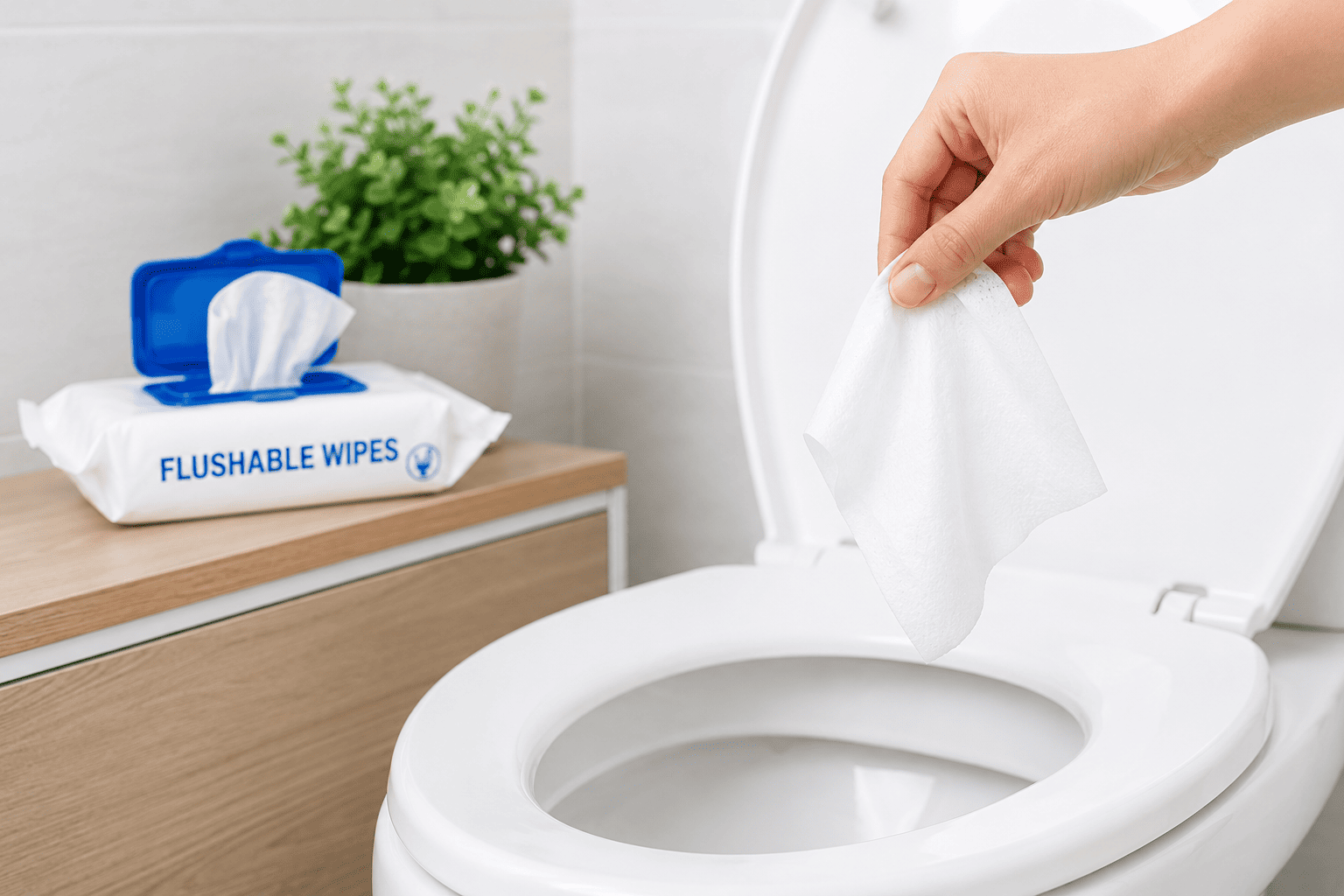


“Flushable” is one of the most misunderstood claims in the wet wipes industry.
A wipe may be soft, plastic-free or made from cellulose-based fibers. It may even break apart when stirred in a glass of water. None of these points alone proves that it is suitable for disposal through a toilet.
A genuinely flushable wipe must be compatible with the journey after flushing. That includes the toilet, household drain, sewer network, wastewater treatment process and, where relevant, the downstream environment. This is why a flushability claim should be supported by a defined assessment method, a finished-product test report and market-appropriate labeling. [1][2]
For private label wet wipes buyers, the practical message is simple: do not approve a flushable claim based on material descriptions alone. Ask the flushable wipes manufacturer which framework applies, which finished product was tested and whether the result supports the exact claim intended for your destination market.
Flushable Does Not Mean the Same as Biodegradable
Biodegradable, plastic-free, compostable, dispersible and flushable are not interchangeable terms.
A biodegradable material may break down under certain environmental conditions. A plastic-free wipe may contain no intentionally added plastic fibers. A dispersible wipe may break into smaller pieces under a defined test. Flushability is broader. It concerns whether a product can pass through plumbing and wastewater systems without causing unacceptable problems. [2][3]
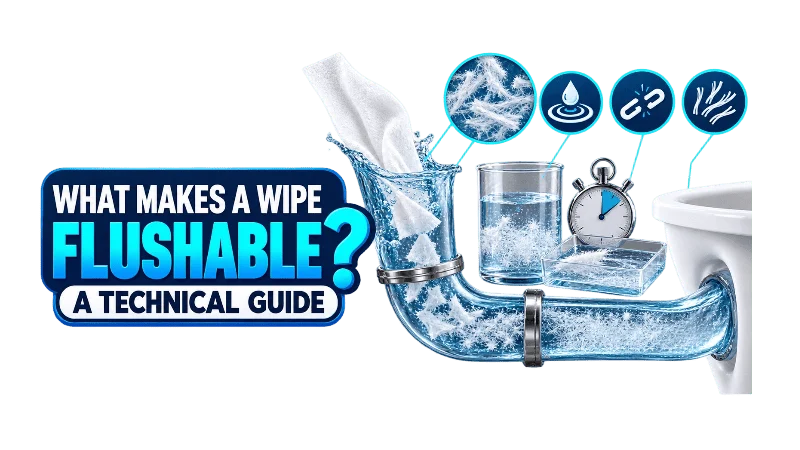
The IWSFG, an international group representing wastewater-service interests, sets out five areas for a product marketed as flushable:
- Environmental protection and material composition
- Toilet and drain-line clearance
- Disintegration
- Settlement
- Biodisintegration [2]
A product must meet all applicable criteria within the IWSFG specification to be recognized as suitable for flushing under that framework. Passing only a fiber-content check or a simple disintegration demonstration is not enough. [2]
This distinction is important for branded wet wipes. A claim that sounds environmentally positive may still be unsuitable for the package if it does not match the test evidence.
A Flushable Wipe Is a Finished Product, Not Just a Fabric
Wet wipes raw material is important, but it is only one part of the product.
Conventional wet wipes often use materials selected for high wet strength, softness and durability. Those qualities can be useful for baby, body or household wipes. However, a wipe designed to stay intact during demanding use may not disintegrate quickly enough for a flushability claim.
Under the IWSFG PAS 1 specification, products should identify fiber type through testing. The specification also states that intentionally added plastic fibers should not be present in a conforming flushable product. [2]
That does not mean every cellulose-based wipe is automatically flushable. This is an inference from the IWSFG criteria: material composition is only one of five requirements, alongside clearance, disintegration, settlement and biodisintegration. [2]
The finished wipe also includes:
- The nonwoven structure and basis weight
- Fiber composition
- Lotion or solution loading
- Wipe dimensions
- Folding and pack compression
- Product age at the time of testing
IWSFG PAS 1 notes that product age can affect disintegration and requires samples used in its PAS methods to be tested at least two weeks after manufacture. [2] A sample made from the right substrate is therefore not a substitute for testing the finished, market-ready product.
GD4 and IWSFG: What Is the Difference?
GD4 and IWSFG are often discussed together, but they are not the same framework.
GD4 refers to the fourth edition of the INDA/EDANA Guidelines for Assessing the Flushability of Disposable Nonwoven Products. It includes an assessment framework and related test methods developed for disposable nonwoven products and wastewater compatibility. INDA describes GD4 as part of its voluntary flushability guidance and labeling framework. [4]
IWSFG publishes Publicly Available Specifications, or PAS documents, from a wastewater-services perspective. Its PAS 1 outlines the five criteria for a flushability claim, while PAS 3 describes the Slosh Box disintegration method. [2][3]
| Framework | Main role | Key point for buyers |
|---|---|---|
| GD4 | Industry guidance for assessing disposable nonwoven products and disposal labeling | Ask whether the proposed finished wipe was assessed against GD4 methods and criteria. [4] |
| IWSFG PAS | Wastewater-focused criteria for products marketed as flushable | Confirm that all five criteria—not only disintegration—have been addressed. [2] |
| ISO/TS 18671:2026 | International technical specification for testing compatibility with wastewater systems and appropriate labeling | Check whether the target market or customer requires testing aligned with this newer ISO technical specification. [5] |
The two approaches share some technical foundations. IWSFG PAS 3 states that its 2020 Slosh Box method is substantially based on the GD4 Slosh Box test method, with permission from INDA and EDANA. [3]
For procurement teams, the best question is not “Which logo does the supplier have?” It is: “Which protocol was used, which exact product was tested, and does the result support our proposed market claim?”
What Do Flushability Tests Examine?
A credible technical evaluation looks beyond whether the wipe leaves the toilet bowl.
1. Toilet and Drain-Line Clearance
A wipe must clear the toilet and continue through the drain line without causing a blockage. Under IWSFG PAS 1, a flush containing the product should not require a plunger to clear the bowl and trap. The drain-line test also evaluates whether the material continues to move rather than repeatedly losing travel distance over consecutive flushes. [2]
This matters because a wipe can appear to flush successfully once but still create problems farther along the household plumbing route.
2. Disintegration
Disintegration measures whether the wipe breaks into sufficiently small pieces under controlled movement in water.
IWSFG PAS 3 uses a Slosh Box method. Under IWSFG PAS 1:2020, more than 80% of the initial dry mass of five test pieces must pass through a 25 mm sieve after 30 minutes of testing, supported by visual examination of retained solids. [2][3]
This is a technical test, not a home demonstration. The specified motion, test duration, sieve size and reporting method matter.
3. Settlement
Wastewater systems are designed to separate and treat solids. A material that remains overly buoyant may not behave as intended during treatment.
The IWSFG settlement criteria require successful specimens to settle at an average speed of at least 1 mm per second through a defined test distance. They also assess whether material rises significantly after settling. [2]
4. Biodisintegration
Biodisintegration considers how the material behaves after it reaches the treatment environment. The IWSFG PAS 1 framework references an anaerobic biodisintegration test and specifies a mass-passing criterion when material remains on the test sieve. [2]
Together, these tests show why a wipe cannot be judged by one property alone. Wet strength, disintegration behavior, movement through water and downstream treatment compatibility must be considered as one system.
Why Flushability Claims Depend on the Market
Flushability is not only a product-development question. It is also a claim, labeling and market-access question.
The United Kingdom’s former “Fine to Flush” specification, WIS 4-02-06, is now marked as archived by Water UK. Its standards page states that the specification was created to set a minimum performance threshold for products marketed as flushable, but that the standard and references to product flushability were archived. [6]
This does not mean buyers should ignore testing. It means they should not treat an old Fine to Flush reference as a current, universal approval route. The target market’s rules, retailer requirements and current wastewater-industry guidance must be checked before package artwork is approved.
The same care applies in every export market. ISO/TS 18671:2026 shows that global approaches include testing methodologies, wastewater-system compatibility and appropriate labeling. It also references regional and national approaches, including Australia, China, Spain and Belgium. [5]
A wet wipes supplier should therefore ask where the product will be sold before recommending a flushable claim.
What Private Label Buyers Should Request
When sourcing flushable wipes, request documents for the final product specification rather than a general statement that the factory can make “flushable wipes.”
A useful technical file should include:
- The proposed fiber composition and wet wipes raw material description
- Finished wipe dimensions, GSM and lotion loading
- The test framework used, such as GD4 or IWSFG PAS
- The laboratory name, test date and exact product tested
- The full test report or a clear summary of pass/fail results
- Evidence that the sample represents the intended production specification
- Proposed packaging claim and disposal instructions
- Change-control requirements for material, formula, size, fold and pack format
IWSFG recommends that testing against its specifications be performed by third-party laboratories accredited to ISO/IEC 17025. [2] This is a sensible procurement benchmark for a product carrying a high-risk disposal claim.
If a supplier changes the material, wipe size, formula or production method after testing, the buyer should ask whether the change affects the test validity. A test result is strongest when it applies to the same specification that will enter wet wipes production.
Choosing a Flushable Wipes Manufacturer
A capable flushable wipes manufacturer should be able to explain the technical limits of the product, not only its marketing benefits.
When comparing wet wipes manufacturers, buyers should ask:
- Which flushability framework do you use for this product?
- Has the exact finished wipe been tested?
- Does the test report apply to our selected material, formula and pack format?
- Which market is the claim designed for?
- Can you provide private label wet wipes and OEM wet wipes support?
- How are material and formula changes controlled after approval?
- Can you support claim review and custom packaging development?
The search phrase “ISWFG Flushable wet wipes manufacturer” is commonly used online, but the correct organization name is IWSFG: the International Water Services Flushability Group. Buyers should use the correct term when reviewing technical documents. [2]
Likewise, rather than looking only for a “GD4 Flushable wet wipes manufacturer,” look for a partner that can explain how GD4 testing, IWSFG criteria, destination-market labeling and finished-product control fit together.
For custom printed wet wipes manufacturers and suppliers, printed film should be approved only after the claim, disposal wording and test scope have been confirmed. This helps avoid costly rework and protects the credibility of the brand.
Final Thoughts
What makes a wipe flushable is not one fiber, one formula or one quick water test.
A product should clear the toilet and drain line, disintegrate under a recognized method, behave appropriately during settlement and biodisintegration, and meet relevant composition and labeling expectations. The IWSFG PAS framework and GD4 guidance provide important technical reference points, while ISO/TS 18671:2026 reflects the continuing move toward internationally recognized test methodologies. [2][4][5]
For brands, retailers and distributors, the safest approach is to treat flushability as a finished-product claim that needs market-specific evidence.
Planning a flushable wipes project? Share your target market, intended claim and reference specification with QIMEI. Our team can help you evaluate the material, formula, packaging and testing pathway before sampling and mass production.
References
[1] International Water Services Flushability Group (IWSFG). IWSFG Flushability Specifications. Available at: https://www.iwsfg.org/iwsfg-flushability-specification/ (accessed September 2026).
[2] International Water Services Flushability Group (IWSFG). PAS 1: 2020—Criteria for Recognition as a Flushable Product. December 2020. Available at: https://www.iwsfg.org/wp-content/uploads/2021/06/IWSFG-PAS-1-Criteria-for-Recognition-as-a-Flushable-Product-2.pdf
[3] International Water Services Flushability Group (IWSFG). PAS 3: 2020—Disintegration Test Methods: Slosh Box. December 2020. Available at: https://www.iwsfg.org/wp-content/uploads/2021/06/IWSFG-PAS-3-Slosh-Box-Test-2.pdf
[4] INDA, Association of the Nonwoven Fabrics Industry. Flushability Test Methods, Guidelines & Code of Practice. Available at: https://www.inda.org/issues-advocacy/flushability/ (accessed September 2026).
[5] International Organization for Standardization (ISO). ISO/TS 18671:2026—Test Methodologies for Assessing the Compatibility of Wet Wipes and Moist Toilet Tissue with Wastewater Collection and Treatment Systems, and Appropriate Labelling. Available at: https://www.iso.org/obp/ui/#iso:std:iso:ts:18671:ed-1:v1:en
[6] Water UK Standards Board. WIS 4-02-06 Issue 1.2: Fine to Flush—Specification for a Testing Methodology to Determine Whether a Product Is Suitable for Disposal Through a Drain or Sewer System. Status: Archived. Available at: https://standards-board.water.org.uk/document/wis-4-02-06-issue-1-2-fine-to-flush-specification-for-a-testing-methodology-to-determine-whether-a-product-is-suitable-for-disposal-through-a-drain-or-sewer-system/