 Meet Qimei at PLMA Chicago 2026 · November 15–17, 2026 · Booth #H3029










Wet wipe folding may look like a small production detail, but it influences package dimensions, stack stability, dispensing and the way consumers use the product. Two wipes made with the same fabric, formula and open-sheet size can behave differently when their folded structures are different.
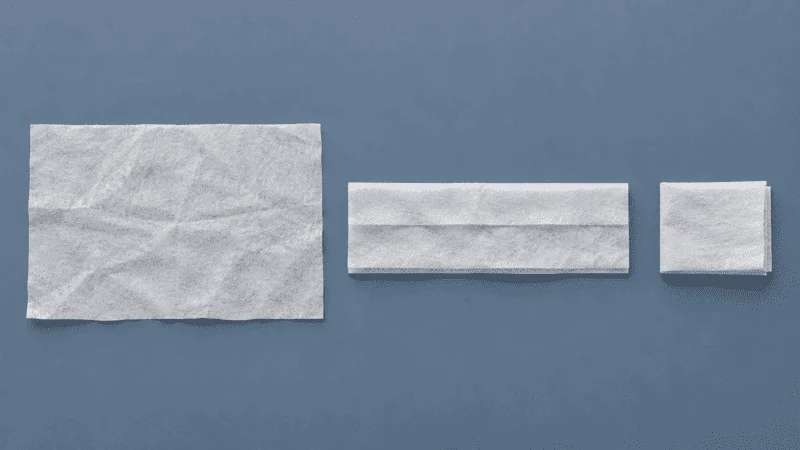
For private label brands, choosing between Z-fold and C-fold should be part of the overall product-development process. The fold must work with the nonwoven fabric, lotion loading, pack count, opening and converting equipment. In this guide, Z-fold and C-fold follow the actual structures described below: Z-fold uses two horizontal fold lines, while C-fold is created by completing the Z-fold and then folding the strip once more from left to right.
Why Does Wet Wipe Folding Matter?
The open dimensions determine how much usable cleaning area a wipe provides. The folded dimensions determine how it fits inside the package. A large wipe may offer good coverage, but it still needs to form a compact, stable stack that can be produced and packed consistently.
Fold selection can affect pack width, stack height, opening position, dispensing resistance and the number of movements required to unfold the sheet. It can also affect machine settings, line speed and packaging-film dimensions.
A fold suitable for a wide baby wipes pack may not work for a narrow travel pack. The best format is therefore not simply the smallest fold. It is the one that balances consumer convenience, package design and manufacturing feasibility.
What Is a Z-Fold Wet Wipe?
In the Z-fold structure discussed here, the open wipe has two parallel horizontal fold lines. These divide the sheet into upper, middle and lower sections. The upper and lower sections are folded in opposite directions around the middle section, creating an accordion-like side profile.
After folding, the wipe retains the full width of the open sheet while its height becomes shorter. The result is a wide, flat rectangular strip.
Potential advantages include:
- A relatively simple folding structure
- Fewer unfolding movements during use
- A wide and flat finished shape
- Efficient use of space in wider soft packs
- Compatibility with different sheet sizes and pack counts
Because the folded wipe remains wide, the package must provide enough internal width. The opening must also allow the user to grip the sheet without excessive pulling force. Z-fold describes the individual sheet only; it does not automatically mean the wipes are interfolded.
What Is a C-Fold Wet Wipe?
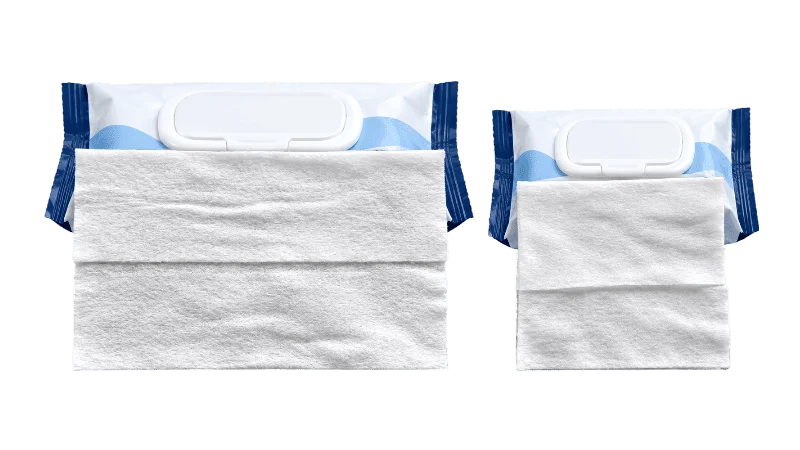
In the format shown in the product sample, a C-fold begins with the same two horizontal folds used for the Z-fold. After the sheet becomes a wide Z-folded strip, it is folded once more along a vertical center line, bringing the left and right halves together.
The process has two stages:
- Fold the upper and lower sections in opposite directions to form the Z-fold.
- Fold the Z-folded strip once from left to right along the center.
This additional fold reduces the final width to approximately half the width of the Z-folded wipe. It produces a narrower footprint but places more layers within a smaller area.
Potential advantages include:
- A narrower final folded shape
- Better compatibility with compact packages
- Efficient packing of relatively large open wipes
- Greater flexibility when determining pack width
The consumer must perform an additional unfolding movement after removing the wipe. This may be acceptable when compact packaging is the priority, but it should be evaluated for products designed for fast or one-handed use.
Fold Type and Interfolding Are Different Specifications
Fold type explains how one wipe is folded. Interfolding explains how neighboring wipes overlap within the stack.
In an interfolded stack, part of one sheet is positioned beneath or inside the next. Pulling the first wipe helps lift the leading edge of the following wipe toward the opening. In a non-interfolded stack, the folded sheets remain separate and removing one does not intentionally present the next.
Neither Z-fold nor C-fold automatically indicates interfolding. The factory must confirm both the individual fold and the stack arrangement.
Interfolding can support pop-up dispensing, but excessive overlap may pull out several wipes together. Insufficient overlap may allow the next wipe to fall back into the pack. The correct overlap must be established through finished-pack testing.
Z-Fold vs C-Fold Wet Wipes: Key Differences
| Factor | Z-Fold | C-Fold |
|---|---|---|
| Folding steps | Two horizontal folds | Z-fold plus one center fold |
| Final width | Retains the full folded width | Approximately half the Z-fold width |
| Final shape | Wide and flat | Narrower and more compact |
| Unfolding | Fewer movements | One additional movement |
| Typical packaging priority | Easy opening and wider packs | Smaller footprint and narrower packs |
| Interfolding | Depends on stack design | Depends on stack design |
| Production requirement | Horizontal folding configuration | Additional center-fold capability |
Neither format is universally better. Z-fold may be preferable when faster unfolding is important. C-fold may be more suitable when a large open sheet must fit into a narrower package.
How Does Folding Affect One-at-a-Time Dispensing?
One-at-a-time dispensing means that the consumer removes one wipe while leaving the next sheet accessible. Fold geometry contributes to this experience, but it cannot guarantee it by itself.
Dispensing also depends on interfold overlap, fabric friction, lotion loading, stack compression, opening dimensions and pulling direction. Excessive overlap or high friction can cause double dispensing. Too little overlap or an oversized opening can cause the next wipe to fall back.
The C-fold’s additional center fold can make the individual sheet more compact. If the stack is tightly compressed, the wipe may require more pulling force or may not open immediately after removal. A Z-fold may open with fewer movements, but it can still dispense poorly when the overlap or packaging is unsuitable.
The complete finished pack must therefore be tested from the first sheet to the last.
How Do Fabric and Lotion Affect Dispensing?
The same fold can perform differently with different nonwoven materials. Viscose, wood pulp, polyester, lyocell and blended substrates have different absorbency, stiffness, wet strength and surface friction.
A soft, highly absorbent sheet may conform closely to the wipe below it, increasing contact between layers. A stronger synthetic or blended substrate may resist stretching during extraction, but its surface may be smoother or more resilient. Embossing can also change how neighboring sheets grip each other.
GSM affects stack volume. A heavier wipe usually creates a thicker stack. If the pack count and package dimensions remain unchanged, higher compression may increase extraction resistance. A lighter wipe may reduce stack height but does not automatically provide better dispensing.
Lotion loading is equally important. Excess liquid can make adjacent sheets cling together and may migrate toward the bottom of the pack during storage. Too little lotion can reduce the intended cleaning performance and change sheet friction. Surfactants, oils, humectants and thickeners may also affect how slippery or tacky the wet fabric feels.
Dispensing trials should always use the intended fabric, embossing and final lotion rather than dry material or water-only samples.
How Does Packaging Design Interact with the Fold?
The folded width establishes the minimum internal width of the pack, while the folded thickness and count influence stack height. Changing from Z-fold to C-fold can therefore require different package dimensions even when the open wipe remains unchanged.
The dispensing opening must be large enough to grip the wipe but controlled enough to help separate sheets and retain the next edge. Its position should align with the stack and extraction direction.
Important variables include opening size, label or lid dimensions, headspace above the stack, film tension and stack compression. The first wipes may be compressed beneath the closure, while the last wipes may sit farther from the opening. Both conditions must be evaluated.
Packaging should not be finalized before the fold and finished stack have been confirmed.
How Does Fold Selection Affect Production and Cost?
The converting line must create the required fold consistently at commercial speed. The C-fold described here requires an additional center fold after the horizontal Z-fold, so the production line must support that operation.
Manufacturing considerations include machine capability, sheet-size limits, cutting accuracy, material tension, number of lanes, line speed, changeover time and waste during adjustment. A standard configuration already used by the factory may be easier to sample and scale than a highly customized structure.
Fold changes can also affect the package footprint and film layout. A narrower stack does not automatically mean lower packaging cost because it may require additional depth, different seals or new artwork dimensions.
Brands should confirm the fold before approving printed film. A late change may require new samples, packaging specifications and artwork adjustments.
What Should Brands Test Before Mass Production?
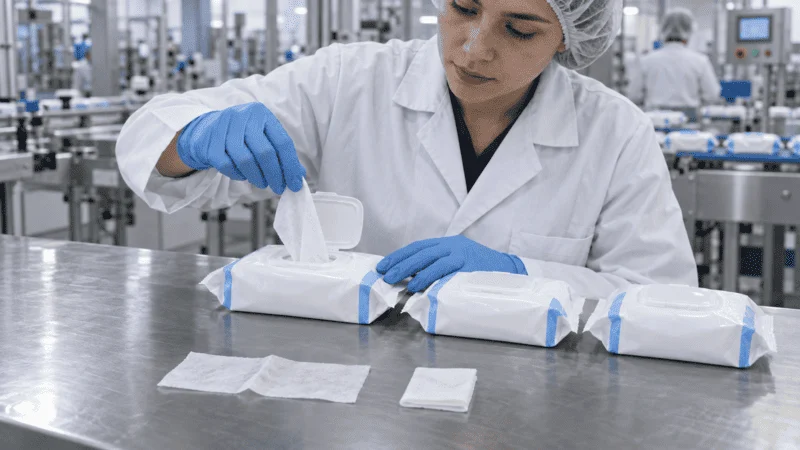
Pre-production samples should use the intended fabric composition, GSM, embossing, formula, lotion loading, fold, stack arrangement, pack count and closure.
Brands should check:
- Whether the first wipe is easy to grip
- Whether one wipe comes out at a time
- Whether the next wipe remains accessible
- Whether sheets tear or stretch during removal
- How easily the wipe unfolds
- Performance in the top, middle and bottom of the pack
- Moisture distribution after storage
- Pack swelling, compression or deformation
- Resealing performance after repeated opening
Several packs should be tested because one successful sample cannot represent production consistency. Testing can also be repeated after temperature conditioning or transport simulation when the product will be exported over long distances.
Acceptance criteria should be agreed before production. For example, the buyer and manufacturer can define the sample quantity and the acceptable occurrence of double dispensing, tearing or sheet fallback.
Frequently Asked Questions About Z-Fold and C-Fold Wet Wipes
1. What is the main difference between Z-fold and C-fold?
In the formats described here, Z-fold uses two horizontal folds. C-fold starts with the same Z-fold and adds one vertical center fold from left to right.
2. Is C-fold simply a Z-fold folded in half?
For this structure, yes. The center fold reduces the final width and creates a more compact shape.
3. Does C-fold require a smaller package?
It can support a narrower package, but the final dimensions must be calculated using the complete stack.
4. Is Z-fold always better for pop-up dispensing?
No. Pop-up performance also depends on interfold overlap, fabric properties, lotion loading, stack compression and opening design.
5. Why do two wipes sometimes come out together?
Possible causes include excessive overlap, high friction, heavy lotion loading, stack compression or an unsuitable opening.
6. Why does the next wipe fall back into the package?
The overlap may be insufficient, the substrate too slippery, the stack displaced or the opening too large.
7. Can the fold be changed after packaging artwork is approved?
It may be possible, but the change can affect folded dimensions, pack size, opening position and film layout. Fold selection should ideally be completed before final artwork approval.
Final Thoughts
Z-fold and C-fold are not interchangeable structures. The Z-fold uses two horizontal folds and retains the full folded width. The C-fold described here adds a center fold, producing a narrower and more compact shape.
Z-fold may offer quicker unfolding, while C-fold may help a large wipe fit into a narrower package. Reliable dispensing, however, depends on the complete system: fold, interfolding, fabric, lotion, stack compression and packaging opening.
Private label buyers should approve the fold with photographs, diagrams and finished-pack samples before mass production. This prevents terminology differences from becoming costly packaging or dispensing problems.
Looking for the right nonwoven fabric for your wet wipes? Contact QIMEI to discuss your product requirements.